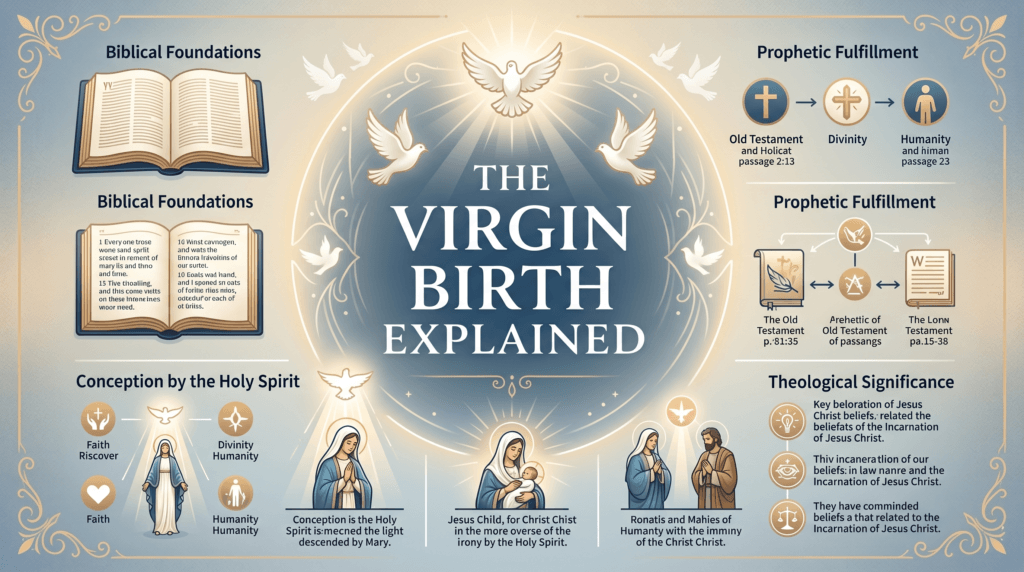
The Virgin Birth is one of those ideas that instantly grabs people’s attention, whether you’re hearing it for the first time or you’ve grown up with it. At its core, it’s the belief that Jesus was born to Mary, who conceived him supernaturally without a biological father. This teaching sits right at the heart of the Christian story and adds a sense of wonder to Christmas. You’ll find it spelled out most clearly in the gospels of Matthew and Luke.
Ever wondered how a story like this became so important, and what it really means for faith today?
Key Points
- Origins in the Gospels of Matthew and Luke
- Connections to Jewish prophetic traditions
- Theological meanings around divinity and humanity
- Historical debates over the story’s details
- Modern reflections and ways people think about the Virgin Birth now
Biblical Roots: Where the Story Begins
Both Matthew and Luke feature the Virgin Birth, but they tell it a little differently. Matthew ties the story back to an old prophecy found in Isaiah, which talks about a young woman (sometimes translated as “virgin”) giving birth to a special child. He wants readers to see Jesus as the fulfillment of ancient hopes. Luke zooms in on Mary and adds the famous words from the angel Gabriel: “The Holy Spirit will come upon you.”
Neither Mark nor John mention the Virgin Birth, which is pretty interesting and has sparked a lot of conversations among scholars. Still, in Matthew and Luke, the story stands out as a sign that something truly unique is happening with Jesus’ arrival. Even today, people who check out the Scriptural accounts can spot the differences and emphasis in each gospel, leading to fresh discussions about what these nuances mean.
Theological Meaning: Why It Matters in Christianity

The Virgin Birth means a lot more than just a miraculous event for early Christians; it’s a way to talk about who Jesus is. According to classic Christian theology, it’s meant to show that Jesus was fully human (since he was born of a woman) and also had a divine origin. This sets him apart as someone with a unique connection to God, and it’s a key piece of why Christians call him “Son of God.”
It’s also a story about God doing something new, without following the usual patterns. The idea is that God could enter the world in an unexpected way, breaking through what people thought was possible. For many believers, this story points out that faith is often about surprises and new beginnings, not just following the same old ways. The Virgin Birth echoes other stories of miraculous births in the Bible, but it steps up the theme in a way that has fueled faith and discussion for centuries.
Historical Questions and Different Interpretations
Since the early days, people have asked plenty of questions about the Virgin Birth. Some early Christian groups accepted it easily, while others had a tougher time. Over the centuries, theologians and historians have debated whether the story should be read as a literal fact, a spiritual truth, or a blend of both. For example, some look at the language Matthew used and point out that the Hebrew word “almah” can mean “young woman” rather than “virgin.”
As Christianity spread, different church traditions put their own spin on the story. The Roman Catholic and Orthodox churches hold it as a central teaching, while some Protestants focus more on what the story represents than on the exact details. Modern historians and bible scholars continue to check out new evidence and interpretations, making the conversation constantly evolve with new perspectives and questions.
Modern Views: How People Relate to the Virgin Birth Today

For a lot of people today, the Virgin Birth is still celebrated every Christmas. It’s part of holiday carols, nativity scenes, and church plays everywhere. Some people see it as a literal event, while others see it as a rich symbol that points to bigger ideas like hope, the power of new beginnings, and God’s closeness to humanity.
People from outside the Christian faith, and even some Christians, sometimes see the Virgin Birth as a myth or a legend. But all these different ways of looking at it keep the conversation alive and show how stories can shape faith, identity, and even culture itself. The continued debate and curiosity surrounding the Virgin Birth can help each generation get a sense of what the story could mean in their own context.
Wrapping Up: Why the Virgin Birth Still Sparks Big Conversations
The Virgin Birth continues to inspire curiosity, debate, and wonder. Whether you see it as history, mystery, or something in between, it’s one of those parts of the Christian tradition that keeps people thinking, asking questions, and finding meaning in new ways with every generation. It fuels both theological discussions and personal reflection, helping people connect faith with real life.
How Does This Story Shape Your Own View?
How do you connect with the story of the Virgin Birth?
If you’ve got thoughts, questions, or a unique angle, drop a comment and join the conversation. Hearing different perspectives helps everyone dig a little deeper into what these stories mean for us now. This is a conversation that grows with us, always offering something new each time we dig into it together.