From Mourning to the First Possession in the Promised Land
Primary Scripture: Genesis 23:1–20
Faith and Promise in the Presence of Death
Genesis 23 brings the reader into a deeply personal moment in Abraham’s journey. Sarah dies, and Abraham mourns for the woman who had shared his long pilgrimage—from their departure from their homeland to their life as strangers in Canaan and finally to the birth of Isaac, the promised son. Yet the chapter does more than record Sarah’s death and burial. Abraham owns no burial ground in the land where God has called him to live. He therefore approaches the people of the land and asks for a burial possession.
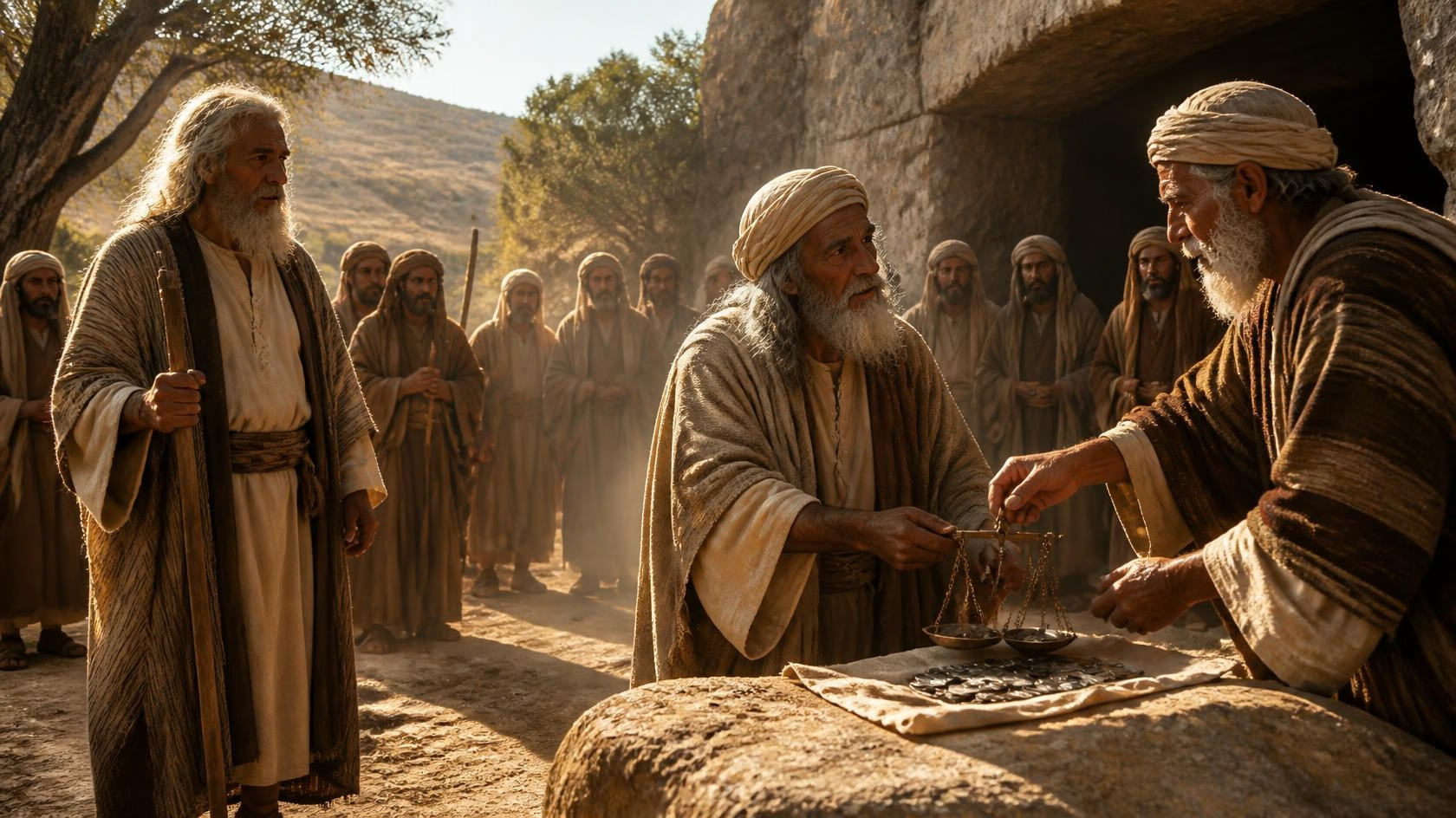
The negotiations that follow are recorded with unusual care. The people involved, the location, the price, the witnesses, and the transfer of the property are all described. Abraham refuses to take the burial place without payment and purchases the field of Ephron at Machpelah, including its cave and trees. Sarah’s burial therefore takes place within a larger biblical movement. Abraham remains a stranger and sojourner in Canaan, but he now possesses a burial place there. The land promised by God has not yet become the inheritance of Abraham’s descendants, but Abraham’s family now has a permanent place within it. Genesis 23 therefore holds grief and promise together. Sarah dies, Abraham mourns, and yet the covenant story continues.
What This Passage Shows
God’s promises remain sure even through death and sorrow. Abraham still lives as a sojourner in the promised land, yet the purchase of Machpelah gives his household a permanent possession there and quietly points toward the continuing fulfillment of God’s promise.
Sarah’s Death Is A Genuine Loss
Genesis 23:1–2 “And Sarah was an hundred and seven and twenty years old: these were the years of the life of Sarah. And Sarah died in Kirjath-arba; the same is Hebron in the land of Canaan.”
Scripture does not rush past Abraham’s grief. He mourns for Sarah and weeps for her. Abraham is a man who has received extraordinary promises from God, but faith does not make him untouched by sorrow. Sarah’s death is a genuine loss. For many years they had shared the same pilgrimage. Together they had left their former home. Together they had lived as strangers. Together they had experienced famine, uncertainty, human failure, divine protection, long years without a child, and finally the fulfillment of God’s promise in Isaac.
Abraham’s description of himself is striking: “a stranger and a sojourner.” God has already promised this land to Abraham’s descendants, yet Abraham still lives within it without possessing it as a national inheritance. There is no contradiction in the narrative. The promise is real, but its complete fulfillment has not yet arrived. Abraham therefore does not simply seize property on the basis of God’s promise. He approaches the inhabitants of the land and seeks a legitimate burial possession. The request is practical and deeply personal: Sarah must be buried. But the language introduces something important. Abraham asks not merely for temporary permission to use a grave. He asks for “a possession of a burying place.” He seeks a place that will belong to him.
Seeking An Acknowledged Transfer Of Property
They offer Abraham the use of their burial places and tell him that none of them will withhold a sepulchre from him. Their response demonstrates Abraham’s standing among the people of the land. He calls himself a stranger and sojourner, yet they regard him with considerable honor. Still, Abraham does not simply accept the use of another person’s tomb. He wants a burial place that will become his own possession.
The request is specific. Abraham wants the cave of Machpelah, located at the end of Ephron’s field, and he wants it “for a possession of a buryingplace.” Again the language of possession appears. Abraham does not ask for secret access, temporary use, or an informal arrangement. He seeks an acknowledged transfer of property. This prepares the way for the public negotiation that follows.
Ephron Is Present Among The Sons Of Heth And Responds Publicly
Genesis 23:10–11 Ephron is present among the sons of Heth and responds publicly. He tells Abraham: “the field give I thee, and the cave that is therein, I give it thee.” The offer appears generous. Ephron speaks before the people of his city and offers both the field and the cave. But Abraham does not accept the property as a gift. This is significant within the narrative because Abraham has already stated his intention to pay the property’s value. He wants the burial place established as his possession through an unmistakable transaction. So the negotiations continue.
Genesis 23:12–16 Abraham bows again before the people and tells Ephron: “I will give thee money for the field; take it of me, and I will bury my dead there.” Ephron then names the price: “The land is worth four hundred shekels of silver.” Abraham does not bargain over the stated amount. Genesis 23:16 records that Abraham weighed out four hundred shekels of silver to Ephron, according to the amount named in the hearing of the sons of Heth. The payment establishes that Abraham purchased the property rather than receiving it as a gift.
Genesis 23:19 Only after recording the completed transaction does Genesis describe Sarah’s burial: “And after this, Abraham buried Sarah his wife in the cave of the field of Machpelah before Mamre: the same is Hebron in the land of Canaan.”
The Field And Cave Become Abraham’s Property
Genesis 23:20 The chapter concludes: “And the field, and the cave that is therein, were made sure unto Abraham for a possession of a buryingplace by the sons of Heth.”
Genesis ends the chapter not simply by repeating that Sarah was buried, but by emphasizing possession. The field and cave have been established as Abraham’s property. This creates a striking contrast. Abraham remains a stranger and sojourner in Canaan, yet he now owns a burial place within that land. The complete land promise has not been fulfilled. Abraham’s descendants have not yet inherited Canaan as a nation. Therefore Machpelah should not be treated as though it were the complete fulfillment of God’s land promise. But neither is the purchase insignificant. Abraham’s family now has a permanent possession within the land where God has promised a future inheritance. The chapter therefore ends quietly, but meaningfully. Sarah has died. Abraham has mourned. A field has been purchased.
Conclusion — What This Passage Shows
Sarah dies in the land of Canaan, and Abraham mourns for her before purchasing the field and cave of Machpelah as a burial place. In grief, Abraham takes possession of a small but significant piece of the land God promised.
Join the Conversation
After reading Genesis 23:1–20, what truth from this passage stands out most clearly to you, and how does it shape your understanding of God and His purposes?
Take a moment to reflect on the passage and share your thoughts in the comments below. Your reflection may encourage another reader in their own journey through God’s Word.
Go Deeper
This article is drawn from a fuller Platinum Study with deeper exposition, Scripture connections, key truths, and interpretive safeguards.