
Genesis Journey · Study No. 30
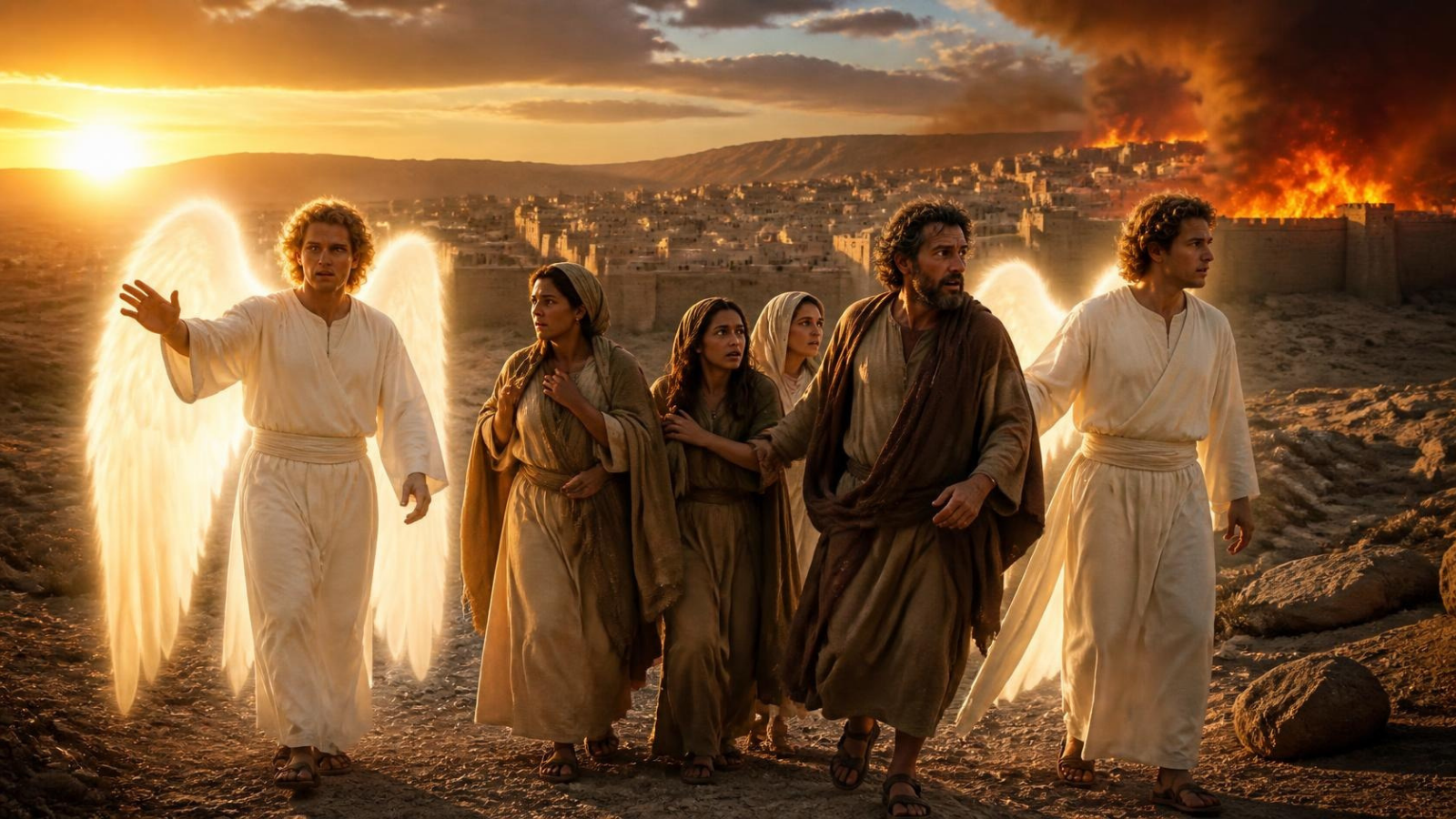
The LORD Being Merciful unto Him — Lot Is Led Out of Sodom
The Angels Warn Lot, Morning Comes, and the LORD’s Mercy Leads His Household Out Before Judgment Falls
Genesis 19:12-22
Study Orientation
Study at a Glance
Primary Scripture
Genesis 19:12-22
Central Theme
As the destruction of Sodom draws near, the angels command Lot to gather his household and leave the city. Lot warns his sons-in-law, but they dismiss his words. When morning comes, the angels urge Lot to flee; yet Lot lingers. At the decisive moment, the LORD’s mercy becomes visible as the angels take Lot, his wife, and his daughters by the hand and bring them outside the city. The passage reveals both the urgency of divine judgment and the compassion of God toward those He delivers.
Central Truth
God’s mercy does not merely warn of coming judgment; it reaches toward the hesitant and leads them toward deliverance. Lot does not escape Sodom because he acts quickly or demonstrates flawless faith. Scripture specifically tells us that he lingered. His rescue rests upon the LORD’s mercy. Yet that mercy does not make the warning optional: Lot must leave Sodom and must not look back. Genesis 19:12–22 therefore holds together God’s righteous judgment, His gracious intervention, and the urgent necessity of responding to His word.
Journey Position
Genesis Journey · Study No. 30
When Mercy Takes Lot by the Hand
Genesis 19:12–22 brings us from the wickedness exposed at Lot’s doorway to the urgent rescue of his household.
The angels announce that Sodom’s destruction is near. Lot warns those connected with his family, but his words are dismissed. Then morning comes, and remarkably, Lot lingers.
At that moment Scripture gives us the key to understanding his escape:
“the LORD being merciful unto him.” — Genesis 19:16
Lot is not presented as the hero of his own deliverance. God warns, urges, reaches toward him, and brings him outside the city.
This study therefore asks us to watch carefully as divine judgment and divine mercy appear together—without diminishing either one.
CHAPTER 1
“Hast Thou Here Any Besides?”
Genesis 19:12
The confrontation at Lot’s house has ended.
The men outside have been struck with blindness, but the mission of the angels is not finished.
They now turn to Lot and ask:
“Hast thou here any besides?”
The question immediately expands the concern beyond Lot himself.
Sons-in-law, sons, daughters—whoever belongs to him in the city must be brought out.
The message is urgent:
“whatsoever thou hast in the city, bring them out of this place.”
Lot has lived in Sodom for years.
Now he is told that everything connected with his life there must be left behind.
The city that once appeared desirable has become a place from which he must flee.
Judgment is no longer merely approaching Sodom.
Lot has been told to leave before it arrives.
CHAPTER 2
“We Will Destroy This Place”
Genesis 19:13
The angels now state their mission plainly:
“For we will destroy this place.”
Why?
The text immediately connects the coming destruction with what the LORD had already revealed to Abraham:
“because the cry of them is waxen great before the face of the LORD.”
Genesis 18:20 had said:
“the cry of Sodom and Gomorrah is great, and because their sin is very grievous.”
Now the angels confirm that the matter has reached its appointed conclusion.
This is important.
The destruction of Sodom is not portrayed as divine impulsiveness.
The LORD has heard.
The LORD has investigated.
The wickedness of the city has been demonstrated.
And now judgment has been announced.
CHAPTER 3
“The LORD Hath Sent Us”
Genesis 19:13
The angels make another crucial statement:
“the LORD hath sent us to destroy it.”
They are not acting independently.
They are messengers carrying out the judgment of the LORD.
This connects Genesis 19 directly to Abraham’s question:
“Shall not the Judge of all the earth do right?” — Genesis 18:25
The Judge who revealed His purpose to Abraham has now sent His messengers into Sodom.
The narrative wants us to understand who ultimately stands behind what is about to happen.
The judgment belongs to the LORD.
And because it belongs to Him, the character of the Judge remains central to understanding it.
CHAPTER 4
Lot Goes to Warn His Sons-in-Law
Genesis 19:14
Lot now acts upon the warning.
He goes out and speaks to his sons-in-law, who are connected with his daughters.
His message is direct:
“Up, get you out of this place; for the LORD will destroy this city.”
For perhaps the first time in the narrative, Lot becomes the bearer of the warning himself.
The angels warned Lot.
Now Lot warns others.
He knows destruction is coming.
He knows escape is still possible.
So he tells his family:
Get out.
But receiving a warning and believing a warning are very different things.
CHAPTER 5
He Seemed as One That Mocked
Genesis 19:14
Lot’s sons-in-law do not respond with urgency.
Scripture says:
“But he seemed as one that mocked unto his sons in law.”
The warning of destruction sounds like a joke to them.
The tragedy is enormous.
They are being offered an opportunity to leave.
But they do not believe the message.
Nothing visible has happened yet.
Sodom still stands.
The houses remain.
Morning has not yet fully arrived.
From their perspective, Lot’s warning may appear absurd.
But the truth of God's warning does not depend upon whether human beings find it believable.
Their unbelief will not prevent the judgment.
It will only prevent them from responding to the warning.
CHAPTER 6
When the Morning Arose
Genesis 19:15
Night passes.
Then Scripture says:
“And when the morning arose…”
This is the final morning of Sodom as Lot has known it.
The city awakens.
Ordinary life may appear ready to continue.
But the divine timetable has reached its appointed hour.
There is a powerful contrast here.
To the inhabitants of Sodom, morning may look like another beginning.
To the angels, morning means the time for Lot to leave has arrived.
The appearance of normality does not mean judgment has disappeared.
Sometimes the final warning comes while everything still appears ordinary.
CHAPTER 7
“Arise”
Genesis 19:15
The angels urge Lot:
“Arise…”
There is no longer time for discussion.
Lot has been warned.
His family has been warned.
Morning has arrived.
Now he must act.
The command is simple:
Get up.
Divine warnings frequently call for a response.
Knowledge alone is not enough.
Lot cannot escape Sodom merely by agreeing that destruction is coming.
He must actually leave.
The passage therefore moves from revelation to response.
God has spoken.
Now Lot must move.
CHAPTER 8
Take Thy Wife and Thy Two Daughters
The angels tell Lot:
“take thy wife, and thy two daughters, which are here.”
The phrase “which are here” is painful.
Lot had gone to warn his sons-in-law.
They did not come.
Now the group being led out consists of Lot, his wife, and the two daughters who remain with him.
Not everyone who heard the warning responded.
Lot cannot force unbelieving people to leave.
The household that actually departs is smaller than the circle he attempted to warn.
The text allows us to feel the cost of unbelief without distracting us from the urgent rescue still taking place.
CHAPTER 9
“Lest Thou Be Consumed”
Genesis 19:15
The warning becomes intensely personal:
“lest thou be consumed in the iniquity of the city.”
Lot lives in Sodom, but he must not share Sodom’s destruction.
The angels therefore command separation before judgment falls.
This echoes the concern Abraham raised in Genesis 18.
Would the righteous be swept away with the wicked?
Genesis 19 is now showing that God knows how to distinguish.
Lot must leave because the city will be judged.
His rescue does not mean Sodom is innocent.
Sodom’s judgment does not mean Lot must necessarily perish with it.
The Judge of all the earth distinguishes.
CHAPTER 10
Lot Lingered
Genesis 19:16
Then comes one of the most surprising statements in the entire account:
“And while he lingered…”
Lot knows the city will be destroyed.
He has heard the angels.
He has warned his family.
Morning has arrived.
He has been told to arise.
And still—
Lot lingers.
Scripture does not explicitly tell us why.
Perhaps possessions, relationships, uncertainty, shock, attachment, or fear played a role.
But those are possibilities, not statements of the text.
What Scripture tells us with certainty is enough:
Lot delayed when he should have departed.
And that makes what happens next extraordinary.
CHAPTER 11
The Angels Take Lot by the Hand
Genesis 19:16
Lot lingers.
The angels do not simply abandon him.
Instead:
“the men laid hold upon his hand…”
This is mercy becoming physical.
Lot is not merely told again what to do.
He is taken by the hand.
The angels also take hold of his wife and his two daughters.
The rescue becomes personal and direct.
Lot’s hesitation has not changed the danger.
But neither has his hesitation exhausted the LORD’s compassion.
God’s messengers reach toward the lingering family.
CHAPTER 12
“The LORD Being Merciful unto Him”
Genesis 19:16
Here Genesis explains the rescue:
“the LORD being merciful unto him.”
This is the theological center of the passage.
Why is Lot being led out?
Scripture itself gives the answer.
The LORD is merciful to him.
This does not mean Lot’s actions are irrelevant.
He still must leave.
He will still receive commands.
But Genesis refuses to make Lot’s deliverance primarily a celebration of Lot.
Lot lingered.
The LORD showed mercy.
That order matters.
The rescue originates in divine compassion.
CHAPTER 13
They Bring Him Forth
Genesis 19:16
The angels:
“brought him forth, and set him without the city.”
Lot has finally crossed the boundary.
He was inside Sodom.
Now he is outside.
But notice how Genesis describes the movement.
Lot does not proudly march out as the master of the situation.
He is brought forth.
The distinction reinforces the message of verse 16.
Deliverance is happening because God intervenes.
Lot participates—he must walk, listen, and flee—but the decisive initiative belongs to the LORD.
The man who once chose the plain of Jordan is now being led away from the city that became part of that choice.
CHAPTER 14
“Escape for Thy Life”
Genesis 19:17
Once outside, the command becomes even more urgent:
“Escape for thy life.”
Being outside the city gate is not enough.
Lot must continue away from the place of judgment.
The instruction is not:
Observe what happens.
It is:
Escape.
There are moments in Scripture when obedience requires decisive separation.
Lot cannot remain close enough to preserve one foot in Sodom.
His life depends upon leaving.
CHAPTER 15
“Look Not Behind Thee”
Genesis 19:17
The command continues:
“look not behind thee.”
Lot is not merely told where to go.
He is told where not to look.
Sodom must be left behind.
This command will become critically important later in Genesis 19.
For now, we should allow it to stand in its immediate context.
The family has been rescued from a city marked for judgment.
They are commanded not to turn back toward it.
Deliverance requires forward movement.
The place from which God has brought them is not a place toward which they should turn again.
CHAPTER 16
“Neither Stay Thou in All the Plain”
Genesis 19:17
Lot is also told:
“neither stay thou in all the plain.”
This is especially striking when remembered alongside Genesis 13.
The plain was precisely what attracted Lot.
He saw that it was well watered.
He chose it.
Now he is told not even to remain within it.
The geography that once represented opportunity has become the geography of danger.
Genesis has brought Lot’s earlier decision full circle.
What appeared attractive by sight was never the whole story.
The spiritual character of the place mattered.
And now Lot must leave the plain he once chose.
CHAPTER 17
“Escape to the Mountain”
Genesis 19:17
The instruction concludes:
“escape to the mountain, lest thou be consumed.”
The destination is clear.
But Lot is afraid.
He has been shown mercy.
He has been brought outside.
Yet his fear has not disappeared.
This reminds us that experiencing God’s mercy does not instantly remove every weakness in the person receiving it.
Lot is delivered, but still fearful.
He has obeyed partially, but he now hesitates over the destination.
The conversation continues.
CHAPTER 18
Lot Pleads for a Little City
Genesis 19:18–20
Lot responds:
“Oh, not so, my Lord.”
He acknowledges the mercy already shown to him.
He says that God has:
“magnified thy mercy, which thou hast shewed unto me in saving my life.”
Lot recognizes something important.
His life has been saved by mercy.
Yet he fears that he cannot escape to the mountain.
So he asks permission to flee instead to a nearby small city.
He emphasizes its smallness:
“Is it not a little one?”
Lot is still negotiating from within his fear.
And remarkably, his request receives an answer.
CHAPTER 19
“I Have Accepted Thee”
Genesis 19:21–22
Lot’s request is granted.
He is told:
“See, I have accepted thee concerning this thing also…”
The small city will not be overthrown.
Then comes another urgent command:
“Haste thee, escape thither…”
Lot must move quickly.
The judgment will not proceed until he reaches the appointed place.
The city receives the name Zoar, connected with Lot’s description of it as a little one.
Once again, mercy accompanies urgency.
Lot is heard.
A place of refuge is granted.
But he must still flee.
CHAPTER 20
Read It Yourself — Genesis 19:12–22
Now return to Genesis 19:12–22 and read the passage without rushing.
Watch the sequence carefully.
The angels warn Lot.
Lot warns his sons-in-law.
They think he is mocking.
Morning arrives.
The angels urge him to leave.
Lot lingers.
The angels take him by the hand.
They take his wife and daughters.
They bring them outside the city.
And Scripture tells you why:
“the LORD being merciful unto him.”
Then notice the commands:
Escape for your life.
Do not look behind you.
Do not remain in the plain.
Escape to safety.
Finally, notice Lot’s response.
He acknowledges God's mercy, yet still fears.
He asks for Zoar.
His request is granted.
As you read, ask:
Who initiates Lot’s rescue?
What does Lot’s lingering reveal about him?
What does the angels’ intervention reveal about God?
Does mercy remove the necessity of obedience—or make escape possible?
And above all, keep Genesis 19:16 at the center:
Lot is outside Sodom because the LORD has been merciful to him.
CONTINUE THE JOURNEY
From Deliverance to Judgment
Lot has now been warned, taken by the hand, brought outside Sodom, and directed toward refuge.
Morning has come.
The sun is about to rise over the land.
Lot will enter Zoar.
Then the judgment announced by the LORD will fall.
Genesis will describe brimstone and fire upon Sodom and Gomorrah, the overthrow of the cities of the plain, and the devastating consequence of looking back.
Yet the narrative will also turn once more toward Abraham.
As he looks toward Sodom, he will see the smoke of the land rising.
And Genesis will explain Lot’s deliverance from another perspective:
“God remembered Abraham, and sent Lot out of the midst of the overthrow.” — Genesis 19:29
The next passage therefore brings together judgment, remembrance, deliverance, and the terrible finality of Sodom’s fall.
Continue to Genesis Study No. 31 — Sodom and Gomorrah Overthrown — The LORD Rains Judgment from Heaven
Primary Scripture: Genesis 19:23–29