Genesis Journey · Study No. 25
Sarai, Abram, and Hagar — The LORD Sees Hagar in the Wilderness
Sarai’s Plan, Hagar and Abram, Conflict in the Household, Hagar’s Flight, and the Angel of the LORD Who Finds Her in the Wilderness
Genesis 16:1–16
Study Orientation
Study at a Glance
Primary Scripture
Genesis 16:1–16
Central Theme
Sarai and Abram seek to obtain the promised offspring through Hagar, bringing conflict and suffering into the household. Yet the LORD finds Hagar in the wilderness, hears her affliction, speaks to her concerning her son, and Hagar recognizes Him as the God who sees her.
Central Truth
Human attempts to accomplish God’s promise in their own way bring painful consequences, but human failure does not overturn God’s purpose. In the wilderness, the LORD sees Hagar, hears her affliction, speaks to her, and demonstrates His sovereign care for someone who is suffering and alone.
Journey Position
Genesis Journey · Study No. 25
Editorial Preface — Reading Scripture First
Genesis 16 follows the covenant promises of Genesis 15 with a painful contrast. The LORD has promised Abram an heir from his own body, yet Sarai remains childless. As the years pass, Sarai proposes a human solution through Hagar, her Egyptian maid. Abram agrees, Hagar conceives, and conflict enters the household.
This study must therefore be read carefully and compassionately. Scripture records the actions of Sarai, Abram, and Hagar without requiring us to approve every human action described. We should distinguish what the text explicitly says from conclusions we might bring to it.
At the center of the chapter stands a remarkable encounter in the wilderness. The angel of the LORD finds Hagar, speaks to her concerning her affliction and her unborn son, and gives the name Ishmael because the LORD has heard her distress. Hagar responds to the LORD who spoke to her as the God who sees her.
Our governing safeguard remains Scripture first. We will follow Genesis 16 in its own order, allow later Scripture to illuminate the passage where appropriate, and distinguish clearly between what Scripture explicitly states, reasonable biblical inference, and later theological interpretation.
CHAPTER 1
Sarai Has No Children
Primary Scripture: Genesis 16:1
Genesis 16 begins with a simple statement carrying enormous weight:
“Now Sarai Abram's wife bare him no children…” — Genesis 16:1
The words take us directly back to the promises already given to Abram. God had called Abram from his country and promised to make of him a great nation. Later, the LORD explicitly told Abram that his heir would come from his own body and that his descendants would be as numerous as the stars.
Yet when Genesis 16 opens, there is still no child.
This creates the tension that governs the chapter.
God has spoken.
The promise remains.
But Abram and Sarai cannot yet see how it will be fulfilled.
The Waiting Has Become Long
Genesis 16 should not be separated from the passing of time.
Abram and Sarai had already journeyed from Haran to Canaan. They had experienced famine, travelled into Egypt and returned, separated from Lot, witnessed the conflict of the kings, and heard the LORD reaffirm His covenant promises.
Still Sarai remained childless.
Genesis 16:3 tells us that Abram had dwelt in Canaan for ten years when Sarai gave Hagar to him.
Waiting therefore forms an important part of the narrative.
The difficulty is not that God has failed to speak.
The difficulty is that what God has spoken has not yet appeared.
That distinction matters throughout Scripture.
Delay is not the same thing as the failure of God's promise.
Scripture First
We should be careful not to put thoughts into Sarai's mind that Genesis does not record.
The text tells us plainly that:
Sarai had borne Abram no children.
Sarai had an Egyptian maid named Hagar.
Sarai subsequently proposed that Abram have children through Hagar.
We can recognize the pressure created by childlessness and the long passage of time, but we should distinguish that reasonable inference from what Scripture explicitly states.
Genesis wants us to see the situation as it actually stands:
God has promised descendants, but Sarai has no child.
That unresolved tension prepares us for what happens next.
Study Reflection
Faith is often tested not only by opposition but by waiting.
Genesis 16 begins at the point where human circumstances appear to stand against the promise of God. The chapter will show what happens when people attempt to solve that tension themselves.
But before examining their actions, we should remember what has not changed:
The LORD's word has not changed.
CHAPTER 2
Sarai Proposes Another Way
Primary Scripture: Genesis 16:2
Sarai now presents Abram with a solution:
“Behold now, the LORD hath restrained me from bearing…” — Genesis 16:2
Her words reveal something important.
Sarai recognizes the LORD's sovereignty over her circumstances. Yet she then proposes a way forward through Hagar.
She tells Abram to go in unto her maid in the hope that she might obtain children through her.
A Human Solution to a Divine Promise
The proposal must be understood within the world in which Abram and Sarai lived, but the biblical narrative itself remains our governing authority.
The central issue in Genesis is not simply whether such an arrangement existed within ancient society.
The larger question is:
How will God's promise be fulfilled?
God had promised Abram descendants.
The promise was certain.
But the method of fulfillment had not yet been completely revealed to Abram and Sarai.
Sarai therefore develops a solution based upon what appears humanly possible.
Hagar can conceive even though Sarai cannot.
From a human perspective, the plan appears capable of solving the problem.
But Genesis will demonstrate that human ability and divine promise are not the same thing.
What Scripture Says — and Does Not Say
At this point we must preserve an important distinction.
Genesis 16:2 records Sarai's proposal, but it does not contain a command from God telling Abram to take Hagar.
That difference is significant.
God's promise stands behind the narrative.
Sarai's plan comes from Sarai.
We should therefore resist treating the plan itself as though it were God's prescribed means of fulfilling His promise.
A Pattern Worth Recognizing
Scripture repeatedly confronts the temptation to substitute human solutions for dependence upon God's word.
That does not mean planning is wrong.
Nor does it mean believers should remain inactive whenever they are waiting.
The issue is whether our actions remain obedient to what God has revealed.
Genesis 16 places that question directly before us.
When God's promise seems delayed, will human beings continue trusting the One who spoke—or attempt to secure the promised outcome by another way?
CHAPTER 3
Abram Listens to Sarai
Primary Scripture: Genesis 16:2
Genesis records Abram's response in only a few words:
“And Abram hearkened to the voice of Sarai.”
The brevity is striking.
There is no recorded objection.
There is no recorded inquiry of the LORD.
There is no new divine command.
Abram listens to Sarai.
An Important Biblical Echo
The wording naturally reminds careful readers of Genesis 3:17, where God tells Adam that he had “hearkened unto the voice of thy wife.”
We should not claim that the two passages are identical in every respect. Their circumstances differ.
Nevertheless, the verbal resemblance is worth observing.
In both narratives, God's previous word provides the larger framework, and human action subsequently introduces painful consequences.
This is a biblical connection, but we should not make it say more than Scripture permits.
Abram Is Responsible for His Decision
Genesis does not portray Abram merely as a passive victim of Sarai's proposal.
He agrees.
That matters.
Sarai proposed the arrangement, but Abram chose to participate in it.
The text therefore prevents us from placing responsibility entirely upon one person.
This becomes increasingly important as conflict develops among Sarai, Abram, and Hagar.
Each person must be understood according to what Scripture actually records.
Faith Does Not Remove Human Weakness
Genesis has already shown remarkable moments of Abram's faith.
He obeyed God's call.
He built altars to the LORD.
He trusted God's promise.
Genesis 15:6 famously declares:
“And he believed in the LORD; and he counted it to him for righteousness.”
Yet immediately afterward, Scripture records a decision whose consequences will become painful.
The Bible does not need to turn its servants into flawless heroes.
Abram's faith is real.
Abram's weakness is also real.
And God's faithfulness does not depend upon pretending otherwise.
CHAPTER 4
Hagar Is Given to Abram
Primary Scripture: Genesis 16:3
Genesis now identifies the timing explicitly:
“And Sarai Abram's wife took Hagar her maid the Egyptian… after Abram had dwelt ten years in the land of Canaan…”
Ten years have passed.
The text then tells us that Sarai gives Hagar to Abram “to be his wife.”
Hagar Is a Person, Not Merely a Solution
At this point Hagar moves from the background of the narrative into its center.
Genesis identifies her as:
Hagar the Egyptian.
She is Sarai's maid.
But as the chapter progresses, Scripture will show that she is not invisible to God.
This becomes one of the great theological truths emerging naturally from Genesis 16.
Human beings may treat another person primarily according to the role that person serves in their plans.
God sees the person.
Before we reach that encounter, however, Scripture requires us to confront the painful human situation that develops.
Ten Years in Canaan
The reference to ten years is important because it helps us appreciate the pressure surrounding the decision without excusing it.
Abram and Sarai have waited.
Nothing visible appears to have changed.
But God's promise has not expired.
Biblical faith must ultimately rest not upon how quickly circumstances change but upon the trustworthiness of the One who speaks.
The Promise Has Not Changed
There is another crucial point.
Nothing Abram, Sarai, or Hagar does in Genesis 16 forces God to rewrite His purpose.
God remains sovereign over the covenant story.
Human actions will have real consequences.
Hagar will suffer.
Sarai will suffer.
Conflict will enter the household.
Ishmael will be born.
Yet the LORD remains faithful to His covenant word.
Genesis is teaching us to distinguish between God's promise and the human attempts made around that promise.
CHAPTER 5
Hagar Conceives
Primary Scripture: Genesis 16:4
The plan succeeds biologically.
Hagar conceives.
But instead of resolving the problem, conception creates a new crisis.
Genesis says:
“And when she saw that she had conceived, her mistress was despised in her eyes.”
What appeared to be the solution now becomes the source of conflict.
Success Is Not the Same as Divine Approval
This is an important biblical principle, provided we state it carefully.
The fact that a human plan produces the intended immediate result does not by itself demonstrate that God approved the method.
Hagar conceives.
The objective has apparently been achieved.
Yet peace does not follow.
Conflict follows.
This is why biblical discernment cannot be based merely upon whether something works.
The governing question remains whether our actions accord with God's revealed will.
Relationships Begin to Fracture
Genesis 16 now changes dramatically.
What began as Sarai's solution becomes tension between Sarai and Hagar.
Hagar's attitude toward Sarai changes after conception.
In the following verses, Sarai's response will intensify the conflict.
The text does not invite us to simplify the narrative into one innocent person and one villain.
Instead, Scripture exposes the brokenness of the entire situation.
Yet God Has Not Lost Control
This point must govern our reading of everything that follows.
The household may be descending into conflict.
But God's covenant purpose is not descending into chaos.
The LORD who promised remains the LORD who governs.
And soon, when Hagar finds herself alone in the wilderness, Genesis will reveal something extraordinary:
The God of Abram is also the God who sees Hagar.
That revelation becomes one of the defining moments of Study 25.
CHAPTER 6
Conflict Enters the Household
Primary Scripture: Genesis 16:5–6
Hagar has conceived, but the hoped-for solution has not brought peace.
Instead, tension now erupts openly.
Sarai says to Abram:
“My wrong be upon thee…” — Genesis 16:5
Sarai reminds Abram that she herself had placed Hagar into his embrace. Yet after Hagar conceived, Sarai says that she became despised in Hagar's eyes.
The household is now experiencing the consequences of a decision intended to overcome Sarai's barrenness.
Sarai Appeals to Abram
Sarai does not treat the conflict merely as a private disagreement between herself and Hagar.
She brings the matter directly to Abram.
Her words are strong:
“The LORD judge between me and thee.” — Genesis 16:5
This statement places the dispute beneath the judgment of God.
But Scripture does not tell us here that the LORD commanded what Sarai or Abram had done. Nor does Genesis record God settling the dispute at this moment.
Instead, Abram responds:
“Behold, thy maid is in thy hand; do to her as it pleaseth thee.” — Genesis 16:6
Abram returns authority over Hagar to Sarai.
Sarai Deals Harshly with Hagar
Then the situation deteriorates further.
Genesis says:
“And when Sarai dealt hardly with her, she fled from her face.” — Genesis 16:6
The wording is important.
We should not soften what Scripture records.
Hagar is treated harshly.
And Hagar flees.
The woman who entered the household's plan as a means of producing an heir now finds herself running away from that household.
Sin Creates Consequences Beyond the Original Decision
Genesis 16 shows how quickly one human decision can affect many lives.
Sarai is distressed.
Abram is caught within the conflict.
Hagar is suffering.
And the unborn Ishmael is carried into the wilderness with his mother.
The consequences are no longer confined to the original decision.
This is one reason Scripture repeatedly calls God's people to trust His wisdom rather than judging merely by what seems immediately effective.
Yet Hagar's Flight Is Not the End
From the human perspective, Hagar is leaving Abram's household.
From the perspective of the biblical narrative, however, she is moving toward an encounter she could not have anticipated.
Hagar may be fleeing from Sarai.
But she is not beyond the sight of God.
CHAPTER 7
Hagar Flees into the Wilderness
Primary Scripture: Genesis 16:6–7
Hagar leaves.
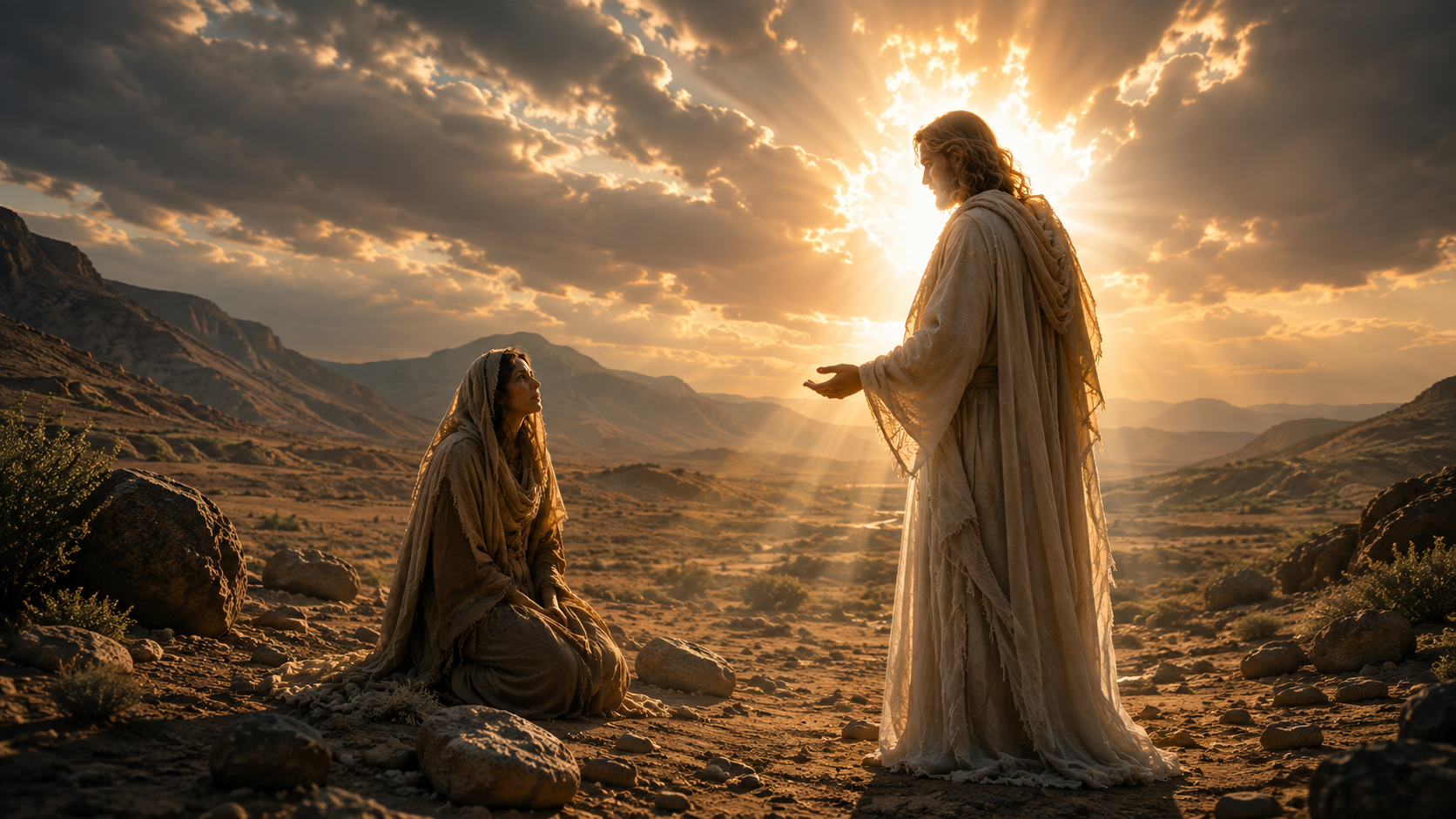
Genesis does not describe an elaborate journey. It simply tells us that she fled from Sarai and was found beside a fountain of water in the wilderness.
The location is described as being:
“by the fountain in the way to Shur.” — Genesis 16:7
Hagar is now away from Abram.
Away from Sarai.
Away from the household in which the covenant promises have been unfolding.
She appears alone.
The Wilderness Changes the Scene
Much of Genesis 16 has taken place within Abram's household.
Now the narrative moves into the wilderness.
This change of location matters.
Hagar no longer possesses the security of the household she has left behind.
Yet the wilderness will become the place where God addresses her personally.
This pattern appears repeatedly throughout Scripture: places of vulnerability can become places in which God's presence and provision are revealed.
But we should allow Genesis 16 itself to establish that truth before drawing broader connections.
Hagar Is Carrying Abram's Son
Hagar does not flee alone.
She is pregnant.
The unborn child is Abram's son.
Therefore, the consequences of what has happened within Abram's household are now physically carried into the wilderness.
Yet the child has not escaped God's knowledge.
Nor has his mother.
An Important Turning Point
Until now, the chapter has been dominated by human speech and human decisions:
Sarai speaks.
Abram listens.
Sarai gives Hagar to Abram.
Hagar conceives.
Sarai complains.
Abram responds.
Sarai treats Hagar harshly.
Hagar flees.
But now the narrative changes.
God intervenes.
The story moves from what human beings are doing to what the LORD will do.
CHAPTER 8
The Angel of the LORD Finds Hagar
Primary Scripture: Genesis 16:7
Genesis 16:7 contains one of the most important sentences in the chapter:
“And the angel of the LORD found her…”
Notice the direction of the action.
Hagar does not first find the angel of the LORD.
The angel of the LORD finds Hagar.
She Is Found in the Wilderness
This is the theological turning point of the chapter.
Hagar has fled from Sarai, but she has not disappeared from God's sight.
The narrative deliberately places her in circumstances where she might appear forgotten.
She is an Egyptian.
She is a servant.
She is pregnant.
She has fled her household.
She is in the wilderness.
Yet heaven knows exactly where she is.
Who Is “the Angel of the LORD”?
Here we must preserve our Scripture-first distinction carefully.
Genesis explicitly identifies the one who encounters Hagar as “the angel of the LORD.”
As the passage continues, the angel speaks with divine authority, and Hagar's response connects the encounter directly with the LORD.
Later biblical passages also present the angel of the LORD in remarkable ways.
Christian interpreters have therefore offered different theological explanations concerning the precise identity of the angel of the LORD, including interpretations connecting these appearances with a pre-incarnate manifestation of Christ.
Those theological discussions can be valuable.
But our first responsibility is to state exactly what Genesis says.
Genesis 16 calls Him “the angel of the LORD,” and the narrative presents His words with divine authority.
We should allow that biblical testimony to govern our study before moving into later theological conclusions.
God Takes the Initiative
This encounter also reinforces a theme already visible throughout Genesis.
God acts first.
God called Abram.
God made promises to Abram.
God established His covenant.
And now, in the wilderness, divine initiative appears again.
Hagar has fled.
The angel of the LORD finds her.
That single sentence changes the direction of her story.
CHAPTER 9
Beside the Fountain on the Way to Shur
Primary Scripture: Genesis 16:7
Genesis gives us another detail:
The angel of the LORD finds Hagar
“by a fountain of water in the wilderness, by the fountain in the way to Shur.”
The location is not incidental.
Hagar's story is occurring in a real geographical setting.
Hagar the Egyptian
Earlier Genesis specifically identified her as:
“Hagar the Egyptian.”
Now she is travelling on the way to Shur, a region associated with the territory toward Egypt.
This naturally raises the possibility that Hagar may have been heading toward her homeland.
However, Scripture does not explicitly tell us her intended final destination.
Therefore we should distinguish carefully:
Explicitly stated: Hagar was Egyptian and was found by a fountain on the way to Shur.
Reasonable inference: She may have been travelling toward Egypt.
Not explicitly stated: Genesis does not say, “Hagar was returning home to Egypt.”
That distinction is important to our study method.
Scripture Does Not Need Our Imagination to Complete It
Biblical narratives sometimes leave questions unanswered.
Where exactly was Hagar intending to go?
How long had she travelled?
What was she thinking beside the fountain?
Genesis does not tell us.
We should not invent emotional dialogue or internal thoughts simply to make the narrative more dramatic.
The inspired text already gives us what matters most:
Hagar fled.
She entered the wilderness.
She reached a fountain.
And there—
the angel of the LORD found her.
Geography Becomes Theology
The wilderness setting now contributes to the central truth of the passage.
God's attention is not confined to Abram's tents.
His knowledge does not stop at the boundary of the covenant household.
The LORD sees what is happening beyond Abram's immediate sight.
And He is about to speak directly to Hagar.
CHAPTER 10
"Hagar, Sarai's Maid"
Primary Scripture: Genesis 16:8
The first recorded words addressed to Hagar are remarkable:
“Hagar, Sarai's maid, whence camest thou? and whither wilt thou go?” — Genesis 16:8
The angel calls her by name.
Hagar.
God Knows Her Name
This is easy to pass over, but it deserves attention.
The narrative has already identified Hagar by name, of course. But within the encounter itself, the angel of the LORD addresses her personally.
She is not merely “the servant.”
She is not merely the woman carrying Abram's child.
She is addressed:
Hagar.
The God who sees her knows who she is.
“Sarai's Maid”
Yet the angel also identifies her relationship to Sarai:
“Hagar, Sarai's maid…”
Her circumstances are not ignored.
God's knowledge of Hagar does not erase the reality from which she fled.
The coming instructions will address that reality directly.
This prevents us from reducing the passage to a sentimental message that God sees Hagar while ignoring everything else the text says.
Yes, God sees her.
But the God who sees her also speaks, commands, promises, and reveals what will happen concerning her son.
The entire encounter must remain together.
Two Questions
The angel asks:
“whence camest thou?”
and
“whither wilt thou go?”
The first concerns where she has come from.
The second concerns where she is going.
Hagar answers only the first:
“I flee from the face of my mistress Sarai.”
She explains where she has come from.
But she does not provide a destination.
Again, we should not make the silence say more than Scripture allows.
Yet narratively, the unanswered question leaves her future open before the word of God.
Hagar Tells the Truth About Her Situation
Hagar does not disguise what has happened.
She is fleeing from Sarai.
The angel of the LORD knows her identity, her relationship to Sarai, and her circumstances.
And now Hagar openly acknowledges her flight.
The next words will be difficult.
The angel will tell Hagar to return.
But those words will not stand alone.
They will be accompanied by an extraordinary promise concerning her descendants and by the naming of the child she carries.
And eventually Hagar herself will respond to the LORD with one of the most memorable declarations in Genesis:
“Thou God seest me.”
CHAPTER 11
"Return to Thy Mistress"
Primary Scripture: Genesis 16:9
After finding Hagar in the wilderness and asking where she has come from and where she is going, the angel of the LORD gives her a direct command:
“Return to thy mistress, and submit thyself under her hands.” — Genesis 16:9
These are difficult words, especially because Genesis has already told us that Sarai dealt harshly with Hagar.
We should therefore handle this verse with care.
The Command Is Specific to Hagar
The text records a particular divine instruction given to Hagar in a particular moment within the unfolding Genesis narrative.
We should not turn Genesis 16:9 into a universal rule requiring every suffering or abused person to remain in, or return to, dangerous circumstances.
That would go beyond what the passage says.
Genesis records what the angel of the LORD told Hagar.
Our task is first to understand that command within Hagar's story.
Returning Does Not Mean God Ignored Her Suffering
The LORD has already demonstrated that Hagar's situation matters to Him.
He found her.
He addressed her personally.
And shortly He will explicitly say:
“the LORD hath heard thy affliction.” — Genesis 16:11
Therefore, the command to return cannot properly be interpreted as evidence that God was indifferent to what had happened to Hagar.
He knows her affliction.
He sees her circumstances.
And He directs her future.
Hagar's Story Is Not Finished
If Genesis 16 ended with Hagar disappearing into the wilderness, the story of Abram's household would move forward without her.
But God intervenes.
Hagar will return.
Her child will be born.
Abram will name him Ishmael.
And Ishmael himself will become part of the continuing Genesis narrative.
The command to return therefore stands within a much larger divine purpose.
CHAPTER 12
"I Will Multiply Thy Seed Exceedingly"
Primary Scripture: Genesis 16:10
The angel of the LORD follows the command with an extraordinary promise:
“I will multiply thy seed exceedingly, that it shall not be numbered for multitude.” — Genesis 16:10
The wording deserves close attention.
The angel does not merely predict that Hagar will have many descendants.
He says:
“I will multiply thy seed.”
A Promise Directly Concerning Hagar
Hagar entered the narrative as Sarai's Egyptian maid.
Now she receives a promise concerning her own descendants.
They will become so numerous that they cannot be counted for multitude.
This does not mean that Hagar and Ishmael replace the covenant line that Genesis will continue to trace.
Later Scripture will make clear that the covenant will be established through Isaac.
But neither should that later distinction cause us to minimize what God actually promises Hagar here.
Both truths must be allowed to stand.
God's covenant purpose will continue through the promised son.
And God genuinely promises multiplication to Hagar's descendants.
God's Sovereignty Extends Beyond the Covenant Line
This becomes an important theme as Genesis progresses.
God's special covenant purposes do not imply that He is unconcerned with everyone outside that covenant line.
Ishmael will not be Isaac.
But Ishmael will not be forgotten.
That distinction is essential.
Scripture allows us to affirm God's unique covenant purpose while simultaneously recognizing His providential care and blessing beyond that line.
The Promise Is God's
Once again, the emphasis falls upon divine action:
“I will multiply…”
Human beings began Genesis 16 attempting to secure a future.
But now God Himself speaks concerning the future.
That contrast runs through the entire chapter.
Human beings devise.
Human beings struggle.
Human relationships fracture.
God speaks and establishes what will be.
CHAPTER 13
"Thou Shalt Bear a Son"
Primary Scripture: Genesis 16:11
The angel of the LORD now tells Hagar something very specific:
“Behold, thou art with child, and shalt bear a son…” — Genesis 16:11
Hagar already knows she is pregnant.
But now God reveals something she does not know from the narrative:
The child will be a son.
And God Himself determines his name.
The Child Is Known Before His Birth
The unborn child is not incidental to the story.
God knows that Hagar carries a son.
God speaks concerning his future.
God determines what he will be called.
This emphasizes the divine knowledge governing the narrative.
The pregnancy arose through the decisions of Abram and Sarai.
But the child who results from those decisions is not therefore outside God's knowledge or providence.
That distinction is important.
Scripture does not require us to approve every human decision in order to recognize God's sovereignty over what follows from it.
God Addresses Hagar as a Mother
Hagar fled as a pregnant servant.
But the divine message speaks directly about her future motherhood.
She will bear a son.
She will name him.
She will have descendants.
The wilderness therefore becomes not merely the place where Hagar's flight is interrupted, but the place where God reveals something about her future.
Human Failure Does Not Defeat Divine Sovereignty
Genesis 16 contains genuine human failure and painful consequences.
Yet God is not improvising because events have escaped His control.
He knows the child.
He knows the mother.
He knows the future.
The narrative therefore holds human responsibility and divine sovereignty together without confusing them.
CHAPTER 14
His Name Shall Be Ishmael
Primary Scripture: Genesis 16:11
The angel continues:
“and shalt call his name Ishmael; because the LORD hath heard thy affliction.” — Genesis 16:11
This is one of the theological centers of the entire chapter.
The child's name carries a message.
Ishmael is associated with the truth that God hears.
And Genesis itself explains why the name is given:
“because the LORD hath heard thy affliction.”
The LORD Has Heard
Hagar may have appeared isolated in the wilderness.
But she was neither unseen nor unheard.
The text does not say merely that God knows abstractly what has happened.
It speaks personally:
The LORD has heard her affliction.
Soon Hagar will emphasize another dimension of this encounter:
God sees.
Together, these truths form a remarkable testimony.
The LORD hears.
The LORD sees.
Ishmael's Name Becomes a Reminder
Every time the child's name is spoken, it carries within it the memory of this wilderness encounter.
His existence is connected with the God who heard Hagar's affliction.
This does not make Ishmael the covenant son promised through Sarah.
Genesis will later make that distinction unmistakable.
But it does mean that Ishmael's story begins under the explicit notice of God.
He is not forgotten.
His mother is not forgotten.
God's Care Does Not Erase God's Covenant Order
This distinction will become increasingly important in Genesis.
God may care for and bless Ishmael while establishing His covenant through Isaac.
Those truths are not contradictory.
Scripture itself holds them together.
Later, in Genesis 17, God will promise concerning Ishmael:
“Behold, I have blessed him…” — Genesis 17:20
Yet in the following verse God says:
“But my covenant will I establish with Isaac…” — Genesis 17:21
Therefore we should not force Scripture into a false choice.
Ishmael receives genuine divine care and blessing.
Isaac will carry the covenant line.
Both are biblical truths.
CHAPTER 15
The Prophecy Concerning Ishmael
Primary Scripture: Genesis 16:12
The angel of the LORD now speaks prophetically concerning Ishmael:
“And he will be a wild man; his hand will be against every man, and every man's hand against him…” — Genesis 16:12
The verse continues:
“and he shall dwell in the presence of all his brethren.”
This passage requires particularly careful interpretation.
What Does “Wild Man” Mean?
The traditional English wording can easily be misunderstood by modern readers.
The Hebrew expression is commonly understood in connection with a wild donkey of a man, an image associated with untamed freedom and life beyond ordinary restraint.
The point should therefore not automatically be reduced to a modern insult about Ishmael's character.
The verse describes something about the kind of existence associated with Ishmael and his descendants—independence accompanied by conflict.
Conflict Is Foretold
The text explicitly says:
“his hand will be against every man, and every man's hand against him.”
Conflict will characterize his relationships.
But we must resist going beyond the text.
Genesis 16:12 is a prophecy concerning Ishmael. It should not be casually transformed into a blanket judgment upon modern ethnic groups, nations, or individual people.
Doing so would require conclusions the verse itself does not state.
Our Scripture-first safeguard is particularly important here.
We Must Not Read Modern Politics Back into Genesis
Throughout history, interpreters have sometimes connected Ishmael directly with later peoples and political conflicts.
Some historical or genealogical connections may deserve careful study in their proper place.
But Genesis 16:12 itself should not be used as a shortcut for explaining every later conflict in the Middle East or for assigning divine judgment to modern populations.
That would move beyond what the inspired text explicitly says.
Genesis tells us about Ishmael.
Our first responsibility is to hear Genesis.
“In the Presence of All His Brethren”
The final statement is also important.
Ishmael will not simply disappear.
He will dwell in relation to his brethren.
Later Genesis will continue his genealogy and describe the development of his descendants.
Therefore, although the covenant narrative will proceed through Isaac, Ishmael remains part of the biblical story.
Scripture Distinguishes Without Dehumanizing
This is one of the most important lessons in reading Ishmael's story faithfully.
Scripture distinguishes Ishmael from Isaac.
But Scripture does not therefore portray Ishmael as invisible to God.
Before Ishmael is even born:
God knows him.
God names him.
God speaks about his future.
God promises numerous descendants through his mother.
And his very name testifies that:
The LORD heard Hagar's affliction.
CHAPTER 16
"Thou God Seest Me"
Primary Scripture: Genesis 16:13
After hearing the command, promise, and prophecy spoken concerning her and her unborn son, Hagar responds:
“And she called the name of the LORD that spake unto her, Thou God seest me…” — Genesis 16:13
This is the defining moment of Genesis 16.
Hagar has been seen.
Notice Whom Genesis Identifies
The wording deserves careful attention.
Earlier, Genesis says:
“And the angel of the LORD found her…” — Genesis 16:7
Yet Genesis 16:13 describes Hagar as calling upon:
“the name of the LORD that spake unto her…”
This is one reason the identity of the angel of the LORD has received considerable theological attention.
But our Scripture-first approach requires us to preserve the wording before constructing theological conclusions.
The text explicitly presents:
the angel of the LORD finding Hagar, and later the LORD speaking to Hagar.
That connection is significant.
We should neither ignore it nor claim that Genesis 16 explicitly provides every later theological explanation of it.
The God Who Sees
Hagar's response brings together the entire wilderness encounter.
Sarai had dealt harshly with her.
Hagar fled.
She entered the wilderness.
But she was not invisible.
The LORD knew where she was.
He knew her name.
He knew where she had come from.
He knew she was pregnant.
He knew her unborn child.
He knew the child's future.
And He knew her affliction.
Hagar therefore responds to the LORD as:
the God who sees her.
More Than Mere Observation
God's seeing in this passage is not presented as distant observation.
His seeing is accompanied by action.
He finds Hagar.
He speaks to Hagar.
He gives her instruction.
He promises descendants.
He names her unborn son.
He acknowledges her affliction.
The God who sees is also the God who acts.
A Truth That Reaches Beyond Hagar
We should first allow Genesis 16 to speak about Hagar.
But the wider testimony of Scripture repeatedly affirms God's complete knowledge of human life.
Psalm 139 declares that the LORD knows our sitting down and rising up and understands our thoughts afar off.
Jesus later teaches that even the hairs of our heads are numbered.
Those passages deepen our understanding of divine knowledge.
Yet Hagar's testimony stands powerfully on its own:
She discovered in the wilderness that she had never been outside God's sight.
CHAPTER 17
Beer-Iahai-roi — The Well of the Living One Who Sees Me
Primary Scripture: Genesis 16:13–14
Hagar continues:
“Have I also here looked after him that seeth me?” — Genesis 16:13
Genesis then explains:
“Wherefore the well was called Beer-lahai-roi…” — Genesis 16:14
The encounter becomes associated with a place.
A Well Becomes a Memorial
Beer-lahai-roi is traditionally understood along the lines of:
“the well of the Living One who sees me.”
The location now carries the memory of what happened there.
Hagar came to a fountain in the wilderness as a fugitive.
She leaves that encounter knowing that the living God sees her.
The geography becomes a testimony.
The Living God
The significance is not merely that Hagar was noticed by some spiritual force.
She has encountered the living God.
Genesis has already revealed the LORD as Creator, Judge, Deliverer, Covenant Maker, and the God who calls Abram.
Genesis 16 now displays another dimension of His character within the narrative:
He sees the afflicted in the wilderness.
Beer-lahai-roi Appears Again
This location does not disappear from Genesis.
Later, Genesis 24:62 associates Isaac with the way of the well Lahai-roi, and Genesis 25:11 says that after Abraham's death, Isaac dwelt by the well Lahai-roi.
The place therefore remains woven into the continuing patriarchal narrative.
What began as Hagar's wilderness encounter leaves a geographical memory within Genesis itself.
The Wilderness Is No Longer Merely a Place of Flight
Hagar entered the wilderness fleeing from pain.
But the place where she was vulnerable became the place where God addressed her.
Her circumstances were not magically erased.
She still had to return.
She still faced a difficult future.
But she returned with something she did not have when she fled:
a word from God.
CHAPTER 18
Hagar Returns and Ishmael Is Born
Primary Scripture: Genesis 16:15–16
The narrative now moves quickly:
“And Hagar bare Abram a son: and Abram called his son's name, which Hagar bare, Ishmael.” — Genesis 16:15
The word spoken in the wilderness comes to pass.
Hagar bears a son.
Abram names him Ishmael.
The Name Reaches Abram's Household
The angel had told Hagar:
“thou shalt call his name Ishmael…” — Genesis 16:11
Now Abram gives the child that very name.
Genesis does not explain in this verse precisely how Abram learned the divinely given name.
We therefore should not invent details.
The important point is what Scripture records:
The child is born, and his name is Ishmael.
The name given in the wilderness now enters Abram's household.
“God Hears”
The child's name permanently carries the testimony of Hagar's encounter.
The LORD heard her affliction.
Every mention of Ishmael recalls, at least linguistically, that foundational truth.
This is especially meaningful because Ishmael's birth emerged from a deeply troubled human situation.
His existence is not treated by Scripture as an embarrassment that must be hidden.
Genesis records his birth.
Genesis records God's promises concerning him.
Genesis later records his descendants.
Abram Is Eighty-Six Years Old
The chapter closes with a chronological marker:
“And Abram was fourscore and six years old, when Hagar bare Ishmael to Abram.” — Genesis 16:16
Abram is 86 years old.
This detail becomes extremely important when Genesis 17 begins.
The next chapter opens:
“And when Abram was ninety years old and nine…” — Genesis 17:1
Approximately thirteen years separate the closing verse of Genesis 16 from the opening of Genesis 17.
Ishmael will therefore grow up in Abram's household before God explicitly announces that Sarah herself will bear the covenant son.
Genesis 16 Ends, but the Promise Is Not Yet Fulfilled
Abram now has a biological son.
But the covenant story is not complete.
Genesis 17 will make the distinction explicit:
God will bless Ishmael.
But His covenant will be established with Isaac, whom Sarah will bear.
The tension between human action and divine promise therefore continues beyond Genesis 16.
CHAPTER 19
What Later Scripture Helps Us See
Canonical Illumination
Genesis 16 must first be understood in its own context.
Only after doing that should we consider how later inspired Scripture refers to these people and events.
Ishmael and Isaac Are Not Interchangeable
Genesis itself will establish the distinction before the New Testament ever addresses it.
God later tells Abraham concerning Ishmael:
“Behold, I have blessed him…” — Genesis 17:20
Then immediately:
“But my covenant will I establish with Isaac…” — Genesis 17:21
Therefore Scripture gives us two truths simultaneously:
Ishmael is blessed.
Isaac carries the covenant line.
We should preserve both.
Paul Uses Hagar Allegorically
In Galatians 4:21–31, Paul later uses Hagar and Sarah within an inspired allegorical argument concerning slavery and freedom, Sinai and promise.
This is important canonical illumination.
But we must maintain the direction of interpretation.
Genesis 16 first tells the historical narrative of Hagar.
Galatians 4 later uses elements of that history within Paul's theological argument.
We should not allow Paul's later allegorical use to erase Hagar as the real woman Genesis describes—a woman who suffered, fled, was found by the angel of the LORD, received promises, and testified that God saw her.
The Promise Advances Toward Christ
The covenant line will proceed through:
Abraham → Isaac → Jacob → Israel
and ultimately, according to the New Testament, toward Jesus Christ.
Paul writes concerning the promises made to Abraham and his seed in Galatians 3, placing Christ at the center of the ultimate fulfillment of God's redemptive purpose.
But Genesis 16 reminds us that the unfolding covenant story includes real people whose lives cannot simply be reduced to theological symbols.
Hagar matters within the narrative.
Ishmael matters within the narrative.
And God's treatment of them reveals something true about God.
Scripture Distinguishes Without Teaching Contempt
This is especially important for readers today.
The biblical distinction between Isaac and Ishmael must never become an excuse for hostility toward contemporary ethnic, national, or religious populations.
Genesis does not authorize such contempt.
Every human being bears the image of God according to Genesis 1:26–27.
And the gospel ultimately announces salvation in Christ across peoples, tribes, tongues, and nations.
We should therefore allow biblical distinctions to remain biblical distinctions without turning them into prejudices Scripture does not command.
The God Who Sees Leads the Story Forward
Genesis 16 begins with Sarai's barrenness.
It ends with Ishmael's birth.
But between those two points lies the chapter's remarkable revelation:
God sees.
God hears.
God finds.
God speaks.
God remains sovereign even amid human failure.
And His covenant promise has not been forgotten.
Genesis 17 is about to make that unmistakably clear.
CHAPTER 20
Read It Yourself — Genesis 16:1-16
The purpose of every Word of GOD study must ultimately be to bring the reader back to Scripture itself.
We have examined Sarai's barrenness.
We have followed her proposal.
We have seen Abram's agreement.
We have watched Hagar conceive.
We have witnessed conflict enter the household.
We have followed Hagar into the wilderness.
And there we have encountered the defining truth of this chapter:
The LORD saw her.
But no study, commentary, theological explanation, or AI-assisted resource should replace reading the biblical text.
Read Genesis 16:1–16 Slowly
As you read, look especially for the progression of the narrative:
Sarai has no child.
↓
Sarai proposes Hagar.
↓
Abram agrees.
↓
Hagar conceives.
↓
Conflict develops.
↓
Hagar flees.
↓
The angel of the LORD finds her.
↓
God speaks concerning her and Ishmael.
↓
Hagar responds to the God who sees her.
↓
Ishmael is born.
Ask the Text
As you read, consider:
What does Genesis explicitly say?
What did God promise?
What did human beings decide?
What consequences followed?
What did the angel of the LORD say?
What did Hagar say about God?
What was promised concerning Ishmael?
And what does the passage not say that later interpreters sometimes assume?
These questions help us remain governed by Scripture rather than by imagination or tradition.
The Central Truth
Genesis 16 does not teach that human choices are without consequences.
They clearly are not.
Nor does it teach that God's covenant purpose can be manufactured through human ingenuity.
Instead, the chapter reveals something deeper.
Human beings may act impatiently.
Relationships may fracture.
People may suffer.
The wilderness may appear lonely.
But God has not lost sight of His people or His purpose.
Hagar discovers this personally.
The LORD hears her affliction.
The LORD sees her.
And the covenant story continues according to God's word.
CONTINUE THE JOURNEY
From Hagar and Ishmael to the Everlasting Covenant
From Hagar and Ishmael to the Everlasting Covenant
Genesis 16 closes with Abram at eighty-six years old and Ishmael newly born.
Genesis 17 opens when Abram is ninety-nine.
Thirteen years have passed.
Then the LORD appears again:
“I am the Almighty God; walk before me, and be thou perfect.” — Genesis 17:1
What follows is one of the great covenant chapters of Scripture.
Abram will become Abraham.
Sarai will become Sarah.
Circumcision will be established as the covenant sign.
Ishmael's future will be addressed.
And God will finally state unmistakably that Sarah herself will bear the promised son:
Isaac.
The story now moves from the God who saw Hagar in the wilderness to the God who formally confirms His everlasting covenant with Abraham.
Continue to Genesis Study No. 26 — Abraham and the Covenant of Circumcision: A New Name and the Promised Son.