Genesis Journey · Study No. 29
Lot Receives the Angels in Sodom — A City on there Eve of Judgement
The Angels Enter Sodom, the City’s Wickedness Is Exposed, and Divine Judgment Draws Near
Genesis 19:1-11
Study Orientation
Study at a Glance
Primary Scripture
Genesis 19:1-11
Central Theme
God’s righteous judgment is never arbitrary: before Sodom is destroyed, Scripture reveals the depth of its corruption while also showing God’s preserving mercy toward Lot. Genesis 19:1–11 places the reader inside Sodom before judgment falls. The wickedness of the city is exposed openly, Lot’s compromised condition is revealed honestly, and the angels intervene when human strength is no longer enough. The passage therefore stands as a concrete answer to Abraham’s question in Genesis 18:25: the Judge of all the earth acts with knowledge, justice, and moral clarity.
Central Truth
The God who judges wickedness also knows how to distinguish, protect, and deliver those who belong to Him. Sodom’s sin is real and grievous, and its judgment is deserved. Yet even in the midst of that corruption, God is not confused about who is righteous and who is wicked. Lot is deeply flawed, but he is not abandoned to the city’s destruction. The same passage that exposes human evil also begins to reveal divine rescue.
Journey Position
Genesis Journey · Study No. 29
When the Angels Enter Sodom
Genesis 19 continues directly from Abraham’s intercession in Genesis 18. The two angels now enter Sodom, where the grievous condition of the city begins to unfold before them.
This is a difficult passage. It records violent human wickedness, Lot’s troubling choices, and God’s direct intervention. We will therefore follow the text carefully, distinguishing between what Scripture records and what Scripture approves.
Above all, this study continues the question raised by Abraham:
“Shall not the Judge of all the earth do right?” — Genesis 18:25
Before Sodom’s judgment falls, Scripture allows us to see why that judgment is coming—and that the Judge of all the earth acts with knowledge, justice, and mercy.
CHAPTER 1
The Two Angels Come to Sodom
Genesis 19:1
Genesis 19 does not begin a completely separate story.
It continues the events of Genesis 18.
At the end of Abraham's intercession, Scripture tells us:
Genesis 18:33 — “And the LORD went his way, as soon as he had left communing with Abraham: and Abraham returned unto his place.”
Genesis 19 then immediately turns our attention toward Sodom.
The two men who had departed toward Sodom in Genesis 18 are now identified plainly:
They are angels.
This is important.
Genesis 18 allowed Abraham—and the reader—to encounter the visitors first in human appearance. Genesis 19 reveals the identity of the two who enter Sodom.
They have not arrived merely as travelers.
Their coming is connected directly with the LORD's investigation and coming judgment announced in Genesis 18:20–21.
The narrative has moved from Abraham standing before the LORD to the angels entering Sodom.
The investigation has reached the city itself.
CHAPTER 2
Evening Falls Upon Sodom
Genesis 19:1
The angels arrive at even.
The detail is simple, but the scene is striking.
Abraham had received the visitors during the heat of the day.
Now the angels reach Sodom as evening approaches.
The city is entering the final night before its destruction.
Yet its inhabitants do not know what is coming.
People are still living their ordinary lives.
The city gates remain active.
Homes are occupied.
The people of Sodom have no visible indication that this night will be unlike every previous night.
But heaven knows.
Genesis therefore places the reader in a solemn position.
We know something the city does not.
Judgment is approaching.
CHAPTER 3
Lot Sits in the Gate of Sodom
Genesis 19:1
When the angels arrive, Lot is sitting:
“in the gate of Sodom.”
This location deserves attention.
Earlier in Genesis, Lot had gradually moved closer to Sodom.
Genesis 13:12 first tells us that Lot:
“pitched his tent toward Sodom.”
Later, Genesis 14:12 describes him as dwelling in Sodom.
Now Genesis 19 finds him sitting at its gate.
The text does not explicitly explain Lot's civic position, so we should be careful not to claim more than Scripture states.
But one thing is unmistakable:
Lot is no longer merely looking toward Sodom from a distance.
He is living within it.
The choices made many chapters earlier have brought him here.
That progression is worth remembering:
He looked toward the well-watered plain.
He chose the Jordan valley.
He pitched toward Sodom.
He dwelt in Sodom.
And now we find him sitting at Sodom's gate.
Choices can carry us farther than their first moment suggests.
CHAPTER 4
Lot Rises to Meet Them
Genesis 19:1
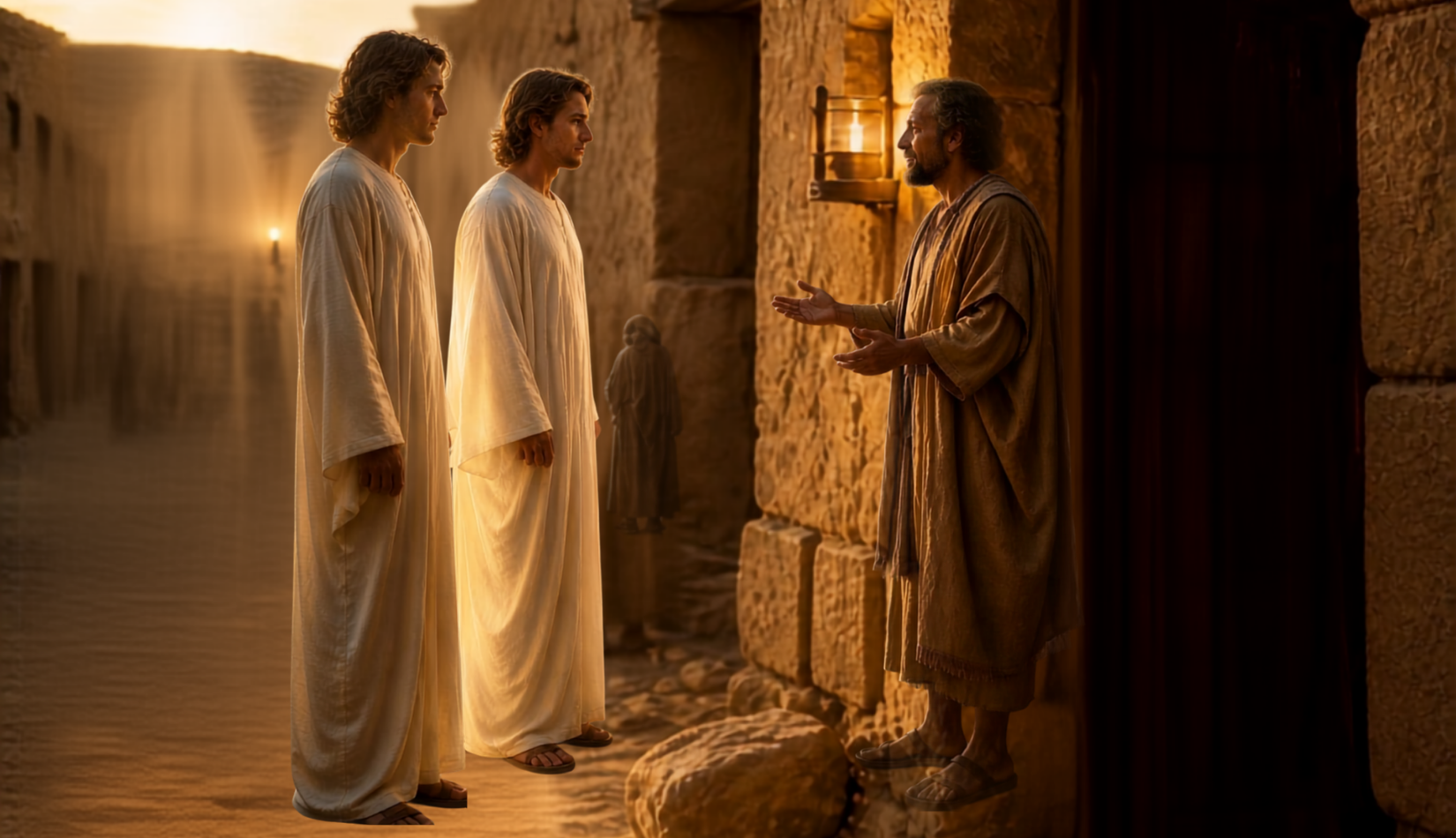
Lot sees the visitors and immediately rises.
Then he bows himself with his face toward the ground.
There is a notable similarity between Lot's reception of the visitors and Abraham's reception in Genesis 18.
Abraham saw the men.
Abraham ran to meet them.
Abraham bowed himself.
Lot likewise sees the visitors, rises, and bows.
Whatever else we will learn about Lot, Scripture shows that he does not treat these strangers with indifference.
He receives them respectfully.
This becomes especially significant when contrasted with the behavior of the city later that same night.
Lot welcomes the strangers.
Sodom will seek to violate them.
The contrast could hardly be greater.
CHAPTER 5
"Turn In, I Pray You"
Genesis 19:2
Lot says:
“Behold now, my lords, turn in, I pray you, into your servant's house.”
He offers them lodging.
He offers water for their feet.
He invites them to remain until morning.
At first, the angels decline.
They say they will:
“abide in the street all night.”
Why Lot is so insistent is not explicitly explained.
But the urgency soon becomes understandable.
Lot knows the city.
He knows what the streets of Sodom may become after nightfall.
His hospitality therefore appears to contain more than courtesy.
There is urgency in it.
He does not merely say, “You may stay with me.”
He presses them to come inside.
CHAPTER 6
Lot Presses Upon Them Greatly
Genesis 19:3
Scripture says:
“And he pressed upon them greatly.”
The visitors finally enter his house.
Lot prepares a feast.
He bakes unleavened bread.
And they eat.
Again there is an echo of Genesis 18, where Abraham prepared food for his visitors.
But the atmosphere is very different.
Abraham's meal took place beneath the trees of Mamre in a scene of hospitality and promise.
Lot's meal occurs inside Sodom on the eve of catastrophe.
Outside the house lies a city whose wickedness has already become the subject of divine investigation.
The meal therefore feels almost like a brief shelter before the darkness outside reveals itself.
CHAPTER 7
Before They Lay Down
Genesis 19:4
The peaceful scene does not last.
Before the visitors retire for the night, the house is surrounded.
Scripture deliberately emphasizes the extent of the gathering:
“the men of the city, even the men of Sodom, compassed the house round, both old and young, all the people from every quarter.”
We should notice the breadth of the description.
This is not presented as the secret misconduct of one isolated individual.
The narrative portrays a public and collective outbreak of wickedness.
Young and old.
From every quarter.
The city gathers around Lot's house.
Genesis 18 told us that the cry of Sodom was great and its sin grievous.
Genesis 19 now begins to show us the kind of evil present there.
CHAPTER 8
The Demand of the Men of Sodom
Genesis 19:5
The crowd calls to Lot:
“Where are the men which came in to thee this night?”
Then comes their demand:
“bring them out unto us, that we may know them.”
The context makes the meaning unmistakably sexual.
This is not hospitality.
It is not curiosity.
It is a threat of sexual violence against strangers who have entered the city.
The scene reveals a society in which vulnerable outsiders are not protected but targeted.
The visitors have been in Sodom only a short time.
Yet the city's wickedness has already come directly to Lot's door.
The outcry described in Genesis 18 is no longer something merely reported.
The reader is now witnessing the evil within Sodom.
CHAPTER 9
Lot Goes Out to the Crowd
Genesis 19:6
Lot does something dangerous.
He goes outside.
He shuts the door behind him.
The visitors remain inside.
Lot now stands between the mob and the strangers under his roof.
Whatever weaknesses Lot possesses—and Genesis will expose serious ones—there is courage in this moment.
He knows these men.
He knows the city.
Yet he walks out to confront them.
Lot attempts to protect his guests.
But what he says next is one of the most disturbing moments in his story.
CHAPTER 10
"Do Not So Wickedly"
Genesis 19:7
Lot addresses the crowd:
“I pray you, brethren, do not so wickedly.”
Lot himself identifies their intention as wickedness.
Scripture does not soften the moral character of what is happening.
The crowd's intention is evil.
Lot understands that.
He pleads with them to stop.
Yet his attempt to solve the crisis will immediately reveal how deeply compromised his own judgment has become.
Living among wickedness does not leave Lot untouched.
That is one of the sobering realities of this chapter.
A person may reject the evil around him and yet still have his moral thinking damaged by prolonged accommodation to it.
CHAPTER 11
Lot Offers His Daughters
Genesis 19:8
Lot tells the mob that he has two daughters who have not known a man.
He offers to bring them out instead.
This is horrifying.
And Scripture gives us no reason to defend Lot's proposal.
His desire to protect his guests does not make the offering of his daughters righteous.
We must distinguish between what the Bible records and what the Bible approves.
Scripture often tells us truthfully what people did without endorsing their actions.
Lot is under enormous pressure.
Ancient hospitality placed serious obligations upon a host.
But none of this transforms the proposed sacrifice of innocent daughters into something good.
Lot condemns the wickedness of the crowd while proposing another terrible wrong.
The scene demonstrates how confused human judgment can become.
CHAPTER 12
"This One Fellow Came In to Sojourn"
Genesis 19:9
The crowd rejects Lot's appeal.
Their response reveals something about Lot's relationship with Sodom.
They say:
“This one fellow came in to sojourn, and he will needs be a judge.”
Lot lives among them.
But in this moment they still regard him as an outsider.
He came as a sojourner.
Now, because he challenges their behavior, they accuse him of judging them.
Their hostility immediately turns toward Lot.
They threaten to treat him worse than the visitors.
The crowd then presses violently against him.
The situation has moved beyond argument.
Lot can no longer control it.
CHAPTER 13
The Door Is About to Break
Genesis 19:9
The men press upon Lot.
They come near to breaking the door.
The barrier between the mob and those inside is about to collapse.
Lot's hospitality cannot save his guests.
Lot's reasoning cannot persuade the crowd.
Lot's position in the city cannot protect him.
Lot's own strength is insufficient.
This matters because Genesis 19 is not ultimately the story of Lot rescuing the angels.
The direction of rescue is about to reverse.
The angels will rescue Lot.
CHAPTER 14
The Angels Pull Lot Inside
Genesis 19:10
The men inside reach out.
They pull Lot into the house.
Then they shut the door.
The one who had gone outside to protect them must now be protected by them.
This is the turning point of the confrontation.
Human ability has reached its limit.
Divine intervention now becomes unmistakable.
Lot cannot master the wickedness surrounding him.
The messengers of God must act.
This anticipates the larger rescue that will follow.
Lot will not ultimately escape Sodom because of his own strength.
He will escape because God intervenes.
CHAPTER 15
The Men Are Struck with Blindness
Genesis 19:11
The angels strike the men outside with blindness.
Scripture says this affects:
“both small and great.”
The crowd had surrounded the house.
Now the aggressors cannot find the door.
The judgment is immediate and fitting.
Those who were determined to force their way into the house lose the ability to locate its entrance.
Yet something remarkable happens.
They do not immediately repent.
They continue trying to find the door.
Genesis says:
“they wearied themselves to find the door.”
Their determination to pursue evil persists even under judgment.
That is one of the darkest details in the passage.
CHAPTER 16
The Outcry Against Sodom
Genesis 19 should be read together with Genesis 18.
The LORD had said:
Genesis 18:20 — “Because the cry of Sodom and Gomorrah is great, and because their sin is very grievous.”
He then declared that He would go down and see.
Genesis 19 now shows the messengers entering the city.
What do they encounter?
A vulnerable pair of strangers arrives.
Lot urgently brings them into his home.
The men of the city surround the house.
They demand the strangers be handed over for sexual violence.
They reject Lot's appeal.
They threaten Lot himself.
They attempt to break through the door.
This sequence is essential.
God's judgment of Sodom is not presented as arbitrary.
The narrative shows grievous evil before the judgment falls.
CHAPTER 17
What Else Does Scripture Say About Sodom?
Later Scripture remembers Sodom in several ways.
Ezekiel speaks of pride, abundance, idleness, and failure to strengthen the poor and needy, followed by abominable conduct before God (Ezekiel 16:49–50).
Jesus uses Sodom as an example when speaking of judgment (Matthew 10:14–15; Luke 17:28–30).
Peter describes the cities' destruction as an example to those who afterward live ungodly lives and identifies Lot as deeply distressed by the wicked conduct around him (2 Peter 2:6–8).
Jude also recalls Sodom and Gomorrah in connection with grave sexual immorality and divine judgment (Jude 7).
These passages help us avoid reducing Sodom's wickedness to a single isolated category.
Scripture presents a broader picture:
pride, injustice, sexual immorality, violence, ungodliness, and entrenched rebellion against God.
Genesis 19 itself places attempted sexual violence at the center of the night's events.
Later Scripture expands our understanding of the city's corruption.
CHAPTER 18
Lot in Sodom
Lot's story should cause us to remember where his journey began.
In Genesis 13, Lot looked toward the plain of Jordan.
It appeared desirable.
The land was well watered.
So Lot chose it.
But Genesis immediately warned us:
Genesis 13:13 — “But the men of Sodom were wicked and sinners before the LORD exceedingly.”
Lot's decision was economically understandable.
Spiritually, however, the environment was dangerous.
Years later, Lot is still there.
And on this night, the wickedness of Sodom arrives at his own front door.
The lesson should not be reduced to the simplistic claim that every difficult environment must immediately be abandoned.
But Genesis does show the danger of choosing primarily according to what looks advantageous while giving insufficient weight to spiritual consequences.
What looked like the best land eventually placed Lot and his household in terrible danger.
CHAPTER 19
What This Passage Reveals About God
Genesis 19:1–11 reveals several truths that should remain anchored to the text.
God sees wickedness.
The cry of Sodom had reached Him.
God investigates justly.
Genesis 18 deliberately portrays His judgment as neither careless nor arbitrary.
God distinguishes between righteousness and wickedness.
That was at the heart of Abraham's intercession.
God is able to intervene when human strength fails.
Lot cannot save himself from the mob.
The angels pull him inside.
And the greater rescue has not yet even begun.
This passage therefore stands directly beneath Abraham's great declaration of confidence:
Genesis 18:25 — “Shall not the Judge of all the earth do right?”
Genesis 19 begins showing the answer through events.
Yes.
The Judge sees.
The Judge knows.
The Judge distinguishes.
And the Judge acts.
CHAPTER 20
Read It Yourself — Genesis 19:1-11
Now return to the biblical text itself.
Read Genesis 19:1–11 slowly.
Notice each movement:
The two angels arrive at Sodom.
Lot sits at the gate.
Lot rises to meet them.
He urges them to enter his house.
They initially propose remaining in the street.
Lot presses them greatly.
They enter.
Lot prepares food.
Before they sleep, the men of Sodom surround the house.
The crowd demands that Lot surrender his visitors.
Lot goes outside.
He calls their intention wicked.
He makes the terrible offer of his daughters.
The crowd rejects him.
They threaten Lot.
They press toward the door.
The angels pull Lot inside.
The men outside are struck with blindness.
Still they exhaust themselves trying to find the door.
Then ask yourself:
What has Genesis actually shown me about Sodom before telling me of its destruction?
What does the passage show about Lot?
Where does Lot act rightly?
Where does he act terribly?
What does the passage reveal about the danger of becoming entangled with a corrupt environment?
Why does Genesis 18:20–21 matter for understanding Genesis 19?
And above all:
What does this passage reveal about the justice of the God who sees what human beings do even when judgment has not yet fallen?
Do not rush beyond the text.
Read it.
Observe it.
Let Scripture establish the truth before interpretation begins.
CONTINUE THE JOURNEY
Continue the Journey
Genesis 19:11 leaves the men outside Lot's house blinded and exhausted.
But the angels did not come merely to survive an attack.
Their mission now becomes explicit.
They will tell Lot that the LORD is about to destroy the city.
Lot must warn those connected with his household.
Yet when he speaks to his sons-in-law, his warning will appear to them as though he is joking.
Then morning will come.
The angels will urge Lot:
“Arise, take thy wife, and thy two daughters, which are here; lest thou be consumed in the iniquity of the city.” — Genesis 19:15
And when Lot hesitates, something extraordinary will happen.
The angels will take him by the hand.
Not because Sodom deserves mercy.
Not because Lot has demonstrated flawless righteousness.
But, as Genesis itself will tell us:
“the LORD being merciful unto him.” — Genesis 19:16
That brings us naturally to:
Genesis Study No. 30
The LORD Being Merciful unto Him — Lot Is Led Out of Sodom
Primary Scripture: Genesis 19:12–22
There we will examine the warning of destruction, Lot's attempt to warn his family, the unbelief of his sons-in-law, Lot's hesitation, the angels taking the family by the hand, and one of the most important statements in the entire account:
“The LORD being merciful unto him.”