
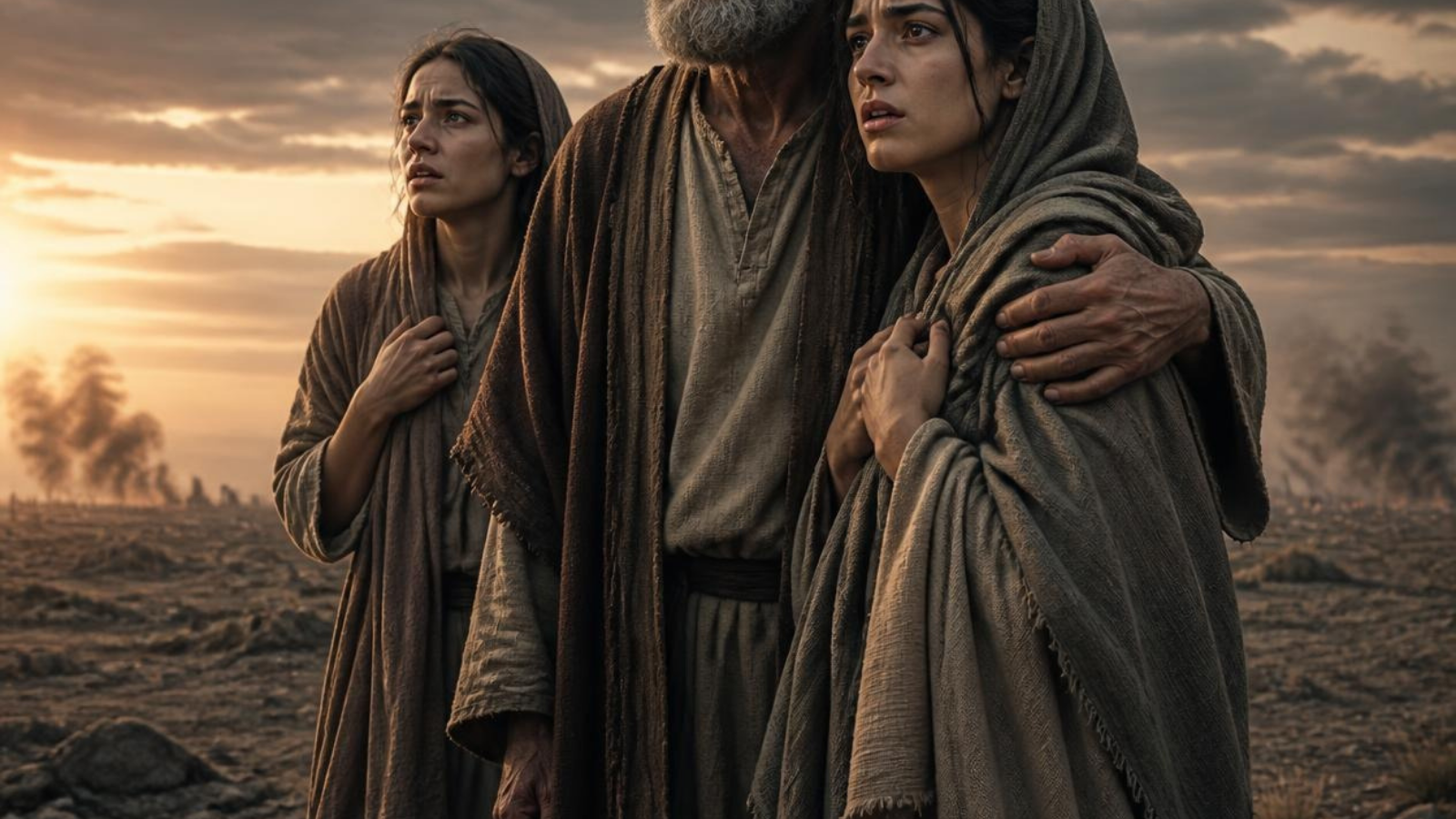
Genesis Journey · Study No. 32
Lot and His Daughters — The Tragic Aftermath of Sodom
Lot Leaves Zoar, His Daughters Act in Fear, and the Origins of Moab and Ammon Are Revealed
Genesis 19:30–38
Study Orientation
Study at a Glance
Primary Scripture
Genesis 19:30–38
Central Theme
After escaping the judgment of Sodom by the LORD’s mercy, Lot and his daughters withdraw from Zoar and live in a cave in the mountains. Fearing that there is no man available through whom they may preserve their family line, Lot’s daughters devise a sinful plan involving their father. Their actions result in the births of Moab and Ben-ammi, ancestors of the Moabites and Ammonites. The passage soberly reveals that physical deliverance from Sodom did not immediately remove the moral consequences and distorted thinking associated with life in that environment.
Central Truth
God’s mercy in delivering people from judgment does not make sinful choices harmless. Genesis 19:30–38 records the disturbing consequences of fear, moral confusion, and human attempts to secure the future apart from faithful trust in God. Yet even this dark episode becomes part of the wider biblical history through which God continues His sovereign purposes.
Journey Position
Genesis Journey · Study No. 32
Reading a Difficult Passage Faithfully
Genesis 19:30–38 is one of Scripture’s most disturbing family accounts. The Bible records what Lot and his daughters did without presenting their actions as morally acceptable. This study will therefore remain close to the biblical text, distinguishing what Genesis explicitly states from reasonable inference and later interpretation. The purpose is neither to sensationalize the episode nor excuse its sin, but to understand its place in Genesis and in the continuing biblical story of Moab and Ammon.
CHAPTER 1
From Sodom to the Mountain
Genesis 19:30
Lot has escaped Sodom and initially settled in Zoar. Yet Genesis now tells us that he leaves Zoar and goes up into the mountain with his two daughters because he is afraid to remain there.
The movement is striking. Earlier, when the angels instructed Lot to flee to the mountain, Lot pleaded for permission to escape instead to the small city of Zoar (Genesis 19:17–22). Now he voluntarily goes to the very mountain he had previously feared.
The text does not explain precisely what caused Lot's fear of remaining in Zoar. We should therefore resist inventing motives Scripture does not give us. What Genesis clearly states is that fear once again shapes Lot's circumstances.
CHAPTER 2
Living in a Cave
Genesis 19:30
Lot and his two daughters dwell in a cave.
The contrast with Lot's earlier life is severe. When Abram and Lot separated, Lot chose the well-watered plain of Jordan and gradually moved his tent toward Sodom. Later we find him living within Sodom itself.
Now the prosperous plain has been devastated, his home is gone, his wife is gone, and Lot is living with his daughters in a cave.
Genesis allows the contrast to speak powerfully. What once appeared to Lot as the more desirable land has ended in devastating loss.
CHAPTER 3
The Elder Daughter Speaks
Genesis 19:31
The firstborn daughter tells the younger that their father is old and that there is no man "in the earth" to come in unto them after the manner of all the earth.
Her statement introduces the reasoning behind what follows.
But Scripture does not tell us that God had declared their family line hopeless. The daughters' perception of their situation must therefore be distinguished from divine revelation.
This is an important interpretive safeguard: the words spoken by a biblical character are not automatically declarations from God.
CHAPTER 4
Fear About the Future
The daughters appear deeply concerned about preserving descendants through their father.
Their circumstances were unquestionably traumatic. They had witnessed the destruction of the region from which they had escaped. Their mother was gone. Their home was gone. Their former social world had disappeared.
Yet Genesis does not explicitly state everything they believed about the wider surviving population.
We therefore recognize their fear without turning assumptions about their thinking into statements of Scripture.
CHAPTER 5
A Human Solution
Genesis 19:32
The elder daughter proposes that they make their father drink wine and then lie with him so that they may "preserve seed" of their father.
Their objective concerns continuation of the family line, but their chosen means are profoundly wrong.
Genesis repeatedly shows the danger of attempting to secure desired outcomes through sinful human schemes rather than trusting God's ordering of life.
A desired outcome does not sanctify sinful means.
CHAPTER 6
Wine and Impaired Judgment
Wine becomes the means by which Lot is rendered unaware of what is happening.
This detail deserves careful treatment. Scripture elsewhere recognizes both ordinary uses of wine and the dangers associated with drunkenness. Here its role is clearly destructive.
Lot's inability to perceive what occurs illustrates the devastating loss of judgment associated with intoxication.
The passage is not primarily a teaching about wine, but the role intoxication plays in the event should not be overlooked.
CHAPTER 7
The First Night
Genesis 19:33
The daughters make Lot drink wine, and the firstborn lies with her father.
Genesis adds an important detail:
Lot did not know when she lay down or when she arose.
The narrative provides no indication that Lot knowingly participated in his daughter's plan that night.
That distinction matters when assigning responsibility according to what the passage actually states.
CHAPTER 8
Scripture Records Without Approving
Genesis describes the event directly, but description must never be confused with endorsement.
The Bible frequently records murder, deception, sexual immorality, idolatry, betrayal, and other sins precisely because it tells the truth about fallen humanity.
The presence of an action in Scripture does not mean God approves it.
This principle is particularly important when reading difficult Old Testament narratives.
CHAPTER 9
The Second Day
Genesis 19:34
The following day, the elder daughter tells the younger what happened and proposes that Lot again be given wine so the younger daughter may do the same.
The plan is therefore deliberate rather than accidental.
The repetition reinforces the seriousness of the daughters' actions.
CHAPTER 10
The Second Night
Genesis 19:35
Lot is again made to drink wine, and the younger daughter lies with him.
Once again Genesis says Lot did not know when she lay down or when she arose.
The repeated wording emphasizes his lack of awareness during both incidents.
Scripture gives us enough information to recognize both the daughters' deliberate planning and Lot's intoxicated condition without requiring us to speculate beyond the text.
CHAPTER 11
Both Daughters Conceive
Genesis 19:36
Both daughters become pregnant by their father.
Their plan accomplishes the biological objective they sought.
But Scripture never teaches that obtaining a desired result proves that the method used was right.
Genesis frequently challenges precisely that kind of reasoning.
Human success and divine approval are not the same thing.
CHAPTER 12
The Birth of Moab
Genesis 19:37
The firstborn daughter gives birth to a son and names him Moab.
Genesis identifies him as:
"the father of the Moabites unto this day."
The story therefore moves beyond Lot's household. It provides an origin account for a people who will later become important in Israel's history.
CHAPTER 13
The Birth of Ben-ammi
Genesis 19:38
The younger daughter also bears a son and names him Ben-ammi.
Genesis identifies him as:
"the father of the children of Ammon unto this day."
Thus two nations closely associated with Israel in later Scripture emerge from the tragic events following Sodom's destruction.
CHAPTER 14
Moab in the Biblical Story
The Moabites appear repeatedly later in Scripture.
Israel encounters Moab during the wilderness period. Balak king of Moab later summons Balaam against Israel (Numbers 22–24). Relations between Israel and Moab subsequently include both hostility and remarkable moments of grace.
Genesis 19 therefore establishes background that later biblical books assume.
The Bible Journey is beginning to reveal why apparently small genealogical details in Genesis matter to the larger story.
CHAPTER 15
Ammon in the Biblical Story
The Ammonites likewise become one of Israel's neighboring peoples.
Their relationship with Israel is complex and often hostile. Yet Deuteronomy later recalls their ancestral relationship through Lot when discussing Israel's journey toward the Promised Land (Deuteronomy 2:19).
Genesis therefore establishes a family connection that continues to matter generations later.
CHAPTER 16
A Remarkable Future Through Moab
One of Scripture's extraordinary developments occurs much later through Ruth the Moabitess.
Ruth becomes part of Israel, marries Boaz, and enters the genealogy leading to David.
Matthew ultimately includes Ruth within the genealogy associated with Jesus Christ (Matthew 1:5).
We must not claim that Genesis 19 itself explicitly predicts this outcome. It does not.
But from the perspective of the completed canon, Scripture reveals an extraordinary trajectory: a people whose beginnings are connected with this deeply broken episode eventually become connected through Ruth to the royal line of David.
CHAPTER 17
Scripture, Inference, and Interpretation
This passage provides an excellent opportunity to practice our permanent BKP safeguards.
Scripture explicitly states: Lot left Zoar because he was afraid, lived in a cave with his daughters, was made drunk, his daughters lay with him without his awareness, both conceived, and their sons became ancestors of Moab and Ammon.
Reasonable inference: the daughters' recent experiences and isolation may have influenced their fearful reasoning.
Interpretation requiring caution: claims about exactly what they believed had happened to the entire human population, or detailed psychological explanations Scripture never supplies.
Faithful Bible study respects these boundaries.
CHAPTER 18
The Long Shadow of Sodom
Lot escaped the physical destruction of Sodom, but the closing verses of Genesis 19 reveal that the story's consequences did not simply disappear when he left the city.
This does not mean Scripture explicitly attributes every action of Lot's daughters to Sodom's influence. That would go beyond the text.
Nevertheless, Genesis has deliberately taken us through Lot's movement toward Sodom, his residence there, the city's wickedness, its destruction, and now the fractured condition of his household.
The narrative invites sober reflection on the consequences of choices and environments.
CHAPTER 19
Mercy Amid Human Brokenness
Genesis 19 contains both divine judgment and divine mercy.
Lot was rescued because God remembered Abraham (Genesis 19:29). Yet the rescued family remains deeply flawed.
This teaches us something important about biblical grace: God's mercy does not depend upon presenting its recipients as morally impressive.
Throughout Scripture, God works amid deeply broken human circumstances without calling evil good.
CHAPTER 20
Key Truths and Scripture Connections
The chapter closes with Moab and Ammon established through Lot's descendants.
Lot now effectively disappears from the Genesis narrative.
The biblical focus returns to Abraham in Genesis 20.
This transition is significant. God's covenant storyline continues—not because every human participant acts faithfully, but because God remains faithful to His purposes.
Genesis is moving us steadily toward the promised son, Isaac.
Key Truths / Scripture Connections
These can remain incorporated within the chapter material under our present Study Builder rather than requiring separate placeholders.
Scripture: Genesis 19:30–38 explicitly records Lot's departure from Zoar, the daughters' scheme, Lot's lack of awareness, the conceptions, and the origins of Moab and Ammon.
Biblical Connection: Deuteronomy 2 later recognizes Moab and Ammon as descendants of Lot.
Canonical Connection: Ruth introduces a faithful Moabite woman into Israel and ultimately the Davidic line.
Jesus Connection: Matthew 1:5 places Ruth within the genealogy leading to Jesus Christ. This means Study 32 should eventually receive a Jesus-page relationship, most naturally under Identity and Prophecy / whole-Bible redemptive storyline, while remaining first and foremost Genesis Study 32.
Interpretive Safeguard: Genesis 19 does not say the daughters believed every other human being on earth had died, nor does it explicitly explain all of their motives. Such conclusions should not be presented as Scripture.
CONTINUE THE JOURNEY
Continue the Journey
The tragic aftermath of Sodom closes Lot's major role in Genesis. The narrative now turns again to Abraham. In Genesis 20, Abraham journeys into the land of Gerar, where fear once again leads him to describe Sarah as his sister. Yet even through human weakness, God protects Sarah and preserves the promised line as the birth of Isaac draws near.
Next: Genesis Study No. 33 — Abraham and Abimelech: God Protects Sarah and the Promised Line