Genesis Journey · Study No. 35
Hagar and Ishmael Sent Away – GOD Hears the Boy in the Wilderness
Sarah Sees Ishmael Mocking, Abraham Sends Hagar Away, and God Provides for Them in the Wilderness
Genesis 21:9-21
Study Orientation
Study at a Glance
Primary Scripture
Genesis 21:9-21
Central Theme
Hagar and Ishmael are sent away from Abraham’s household, but God hears Ishmael in the wilderness, provides for them, and preserves the boy according to His promise.
Central Truth
God establishes His covenant line through Isaac without abandoning Ishmael. When Hagar reaches the end of her own resources, God hears the boy, opens Hagar’s eyes to His provision, and reaffirms that Ishmael will become a great nation.
Journey Position
Genesis Journey · Study No. 35
Promise, Separation, and Providence Faithfully
Genesis 21:9–21 brings together several truths that must be read carefully. Isaac is the promised son through whom God has determined that Abraham’s covenant offspring will be named. At the same time, Ishmael is Abraham’s son, and God has already promised that He will make a nation of him.
The passage records Sarah’s demand that Hagar and Ishmael be sent away, Abraham’s distress, God’s instruction to Abraham, Hagar’s anguish in the wilderness, and God’s intervention on behalf of Ishmael.
This study will therefore remain close to the biblical text. Where Scripture explicitly speaks, we will state it plainly. Where conclusions require reasonable inference, we will identify them accordingly. Later theological interpretation will not be presented as though it were part of the Genesis narrative itself.
The purpose is to understand both the covenant distinction involving Isaac and the remarkable providence of God toward Hagar and Ishmael.
CHAPTER 1
Isaac Grows and Is Weaned
Genesis 21:8 moves the story beyond Isaac’s birth. The child grows, and Abraham makes a great feast on the day Isaac is weaned.
The promised child has survived infancy and is growing within Abraham’s household.
The celebration therefore marks more than an ordinary family milestone. The son whose birth had seemed humanly impossible is now visibly growing before Abraham and Sarah.
Yet the celebration becomes the setting for a serious conflict within the household.
CHAPTER 2
Sarah Sees Ishmael
Genesis 21:9 turns attention from Isaac to Hagar’s son.
Sarah sees the son whom Hagar the Egyptian had borne to Abraham “mocking.”
The text identifies Ishmael through his relationship to Hagar at this point, recalling the events of Genesis 16 and the complicated history that brought him into Abraham’s household.
What Sarah observes becomes the immediate cause of her demand to Abraham.
CHAPTER 3
What Does "Mocking" Mean?
Genesis 21:9 describes Ishmael with a Hebrew expression related to laughter or playing.
The precise character of his behavior has been discussed extensively. The immediate Genesis text does not provide a detailed description of exactly what Ishmael was doing.
Therefore, we should avoid supplying details that Genesis itself does not give.
What is explicit is that Sarah sees his behavior and regards the situation as serious enough to demand separation between Hagar’s son and Isaac.
CHAPTER 4
Sarah Demands Their Removal
Sarah tells Abraham:
“Cast out this bondwoman and her son.”
She gives a specific reason: Hagar’s son must not inherit with Isaac.
Sarah therefore connects the family conflict directly with inheritance.
The issue has moved beyond personal tension between Sarah and Hagar. The future place of the two sons within Abraham’s household has now become central.
CHAPTER 5
Isaac and the Question of Inheritance
Sarah identifies Isaac as her son and insists that Hagar’s son will not share the inheritance with him.
Genesis has already established Isaac as the promised covenant son.
God had told Abraham:
“Sarah thy wife shall bear thee a son indeed; and thou shalt call his name Isaac.”
—Genesis 17:19
The covenant distinction between Isaac and Ishmael therefore did not originate with Sarah. God had already declared that His covenant would be established with Isaac.
CHAPTER 6
Abraham Is Deeply Distressed
Genesis 21:11 gives an important glimpse into Abraham’s response.
Sarah’s demand is “very grievous” in Abraham’s sight.
Why?
Scripture gives the reason plainly:
“because of his son.”
Ishmael is not merely Hagar’s child to Abraham. He is Abraham’s son.
The coming separation therefore causes Abraham genuine personal distress.
CHAPTER 7
GOD Speaks to Abraham
God addresses Abraham’s distress directly.
He tells Abraham not to be grievous because of the lad and because of Hagar.
Then comes a difficult instruction:
“in all that Sarah hath said unto thee, hearken unto her voice.”
Abraham is to permit the separation.
But God immediately explains this command within the larger covenant purpose.
CHAPTER 8
"In Issac Shall Thy Seed Be Called"
God declares:
“for in Isaac shall thy seed be called.”
—Genesis 21:12
This is one of the central statements of the passage.
Isaac occupies a unique place in the covenant purpose God has revealed to Abraham.
This does not mean Ishmael ceases to be Abraham’s biological son. Rather, Genesis distinguishes between Abraham’s physical descendants and the particular covenant line God has chosen to continue through Isaac.
CHAPTER 9
GOD Has Not Forgotten Ishmael
Immediately after affirming Isaac’s covenant role, God speaks about Ishmael.
“And also of the son of the bondwoman will I make a nation, because he is thy seed.”
—Genesis 21:13
This balance is essential.
Isaac: the covenant line.
Ishmael: also Abraham’s son and the recipient of a divine promise concerning his descendants.
God’s election of Isaac does not mean divine indifference toward Ishmael.
CHAPTER 10
Abraham Acts Early in the Morning
Genesis 21:14 says Abraham rises early.
He takes bread and a bottle of water and gives them to Hagar.
He also gives her the child and sends her away.
The scene is brief and painful.
Scripture does not record a lengthy farewell conversation. It simply tells us that Hagar departs.
The household that had contained Abraham, Sarah, Isaac, Hagar, and Ishmael is now permanently divided.
CHAPTER 11
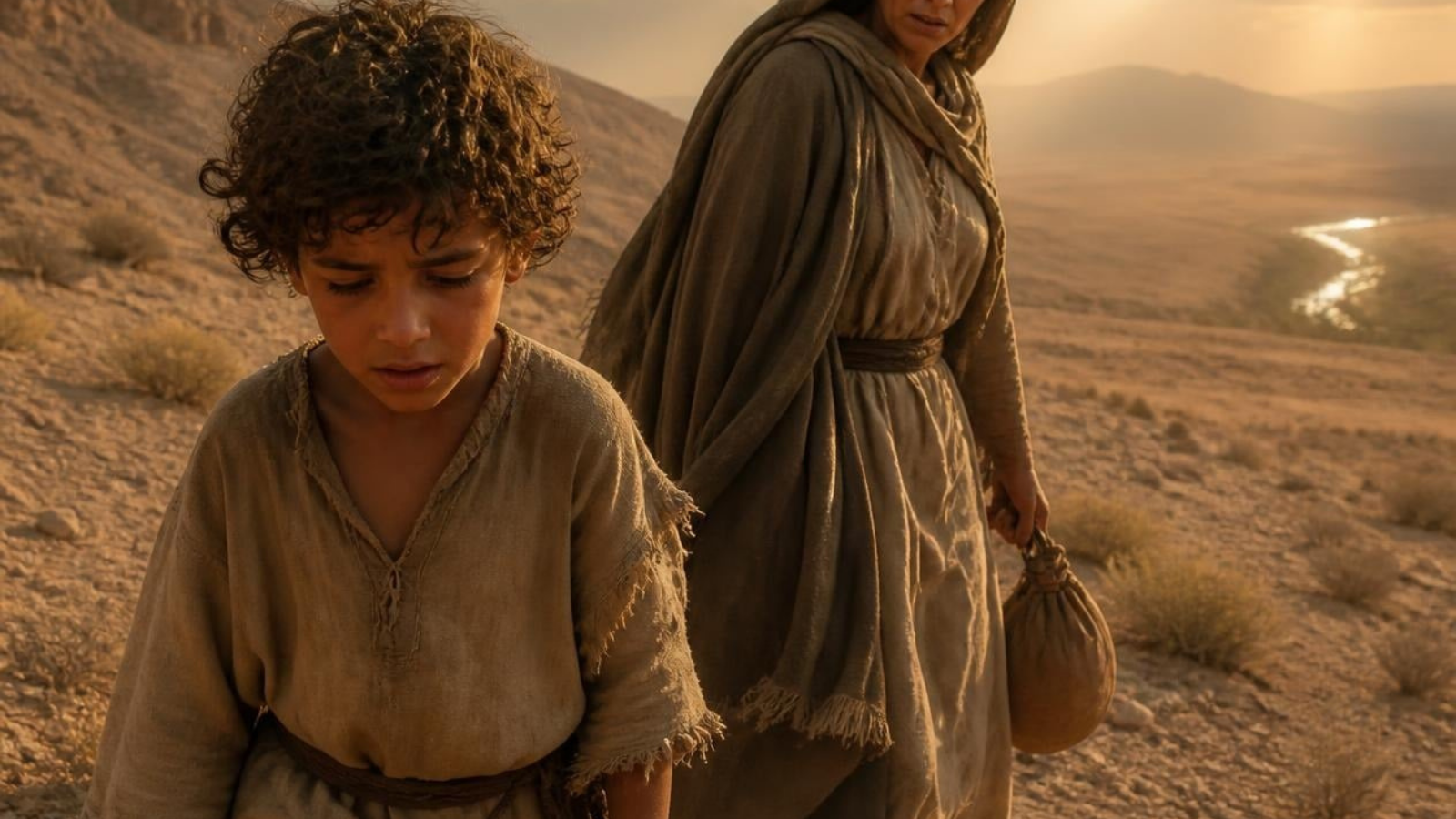
Hagar Wanders in the Wilderness
Hagar enters the wilderness of Beersheba.
Genesis says she “wandered.”
The word communicates the vulnerability of her situation.
She is outside Abraham’s household with limited provisions and a child dependent upon her.
Then the water runs out.
What began as separation from Abraham’s household becomes a struggle for survival.
CHAPTER 12
The Water Is Spent
Genesis 21:15 states simply:
“And the water was spent in the bottle.”
This small statement changes everything.
Hagar no longer possesses the resource necessary to keep herself and Ishmael alive in the wilderness.
Human provision has reached its limit.
The narrative now moves toward one of Hagar’s darkest moments.
CHAPTER 13
Hagar Places the Boy Under a Shrub
When the water is gone, Hagar places Ishmael beneath one of the shrubs.
She then moves away.
Her reason is heartbreaking:
“Let me not see the death of the child.”
Hagar believes Ishmael is going to die.
She cannot bear to watch.
The woman who once fled into the wilderness in Genesis 16 is again in the wilderness—this time facing what appears to be the loss of her son.
CHAPTER 14
Hagar Weeps
Hagar sits some distance away and lifts up her voice and weeps.
Genesis does not minimize her anguish.
There is no indication at this moment that Hagar can see a solution.
Yet the reader already knows something Hagar may not fully perceive in her despair:
God has made a promise concerning Ishmael.
His story cannot end here if God's word is to stand.
CHAPTER 15
GOD Hears the Voice of the Boy
Then comes the turning point:
“And God heard the voice of the lad.”
—Genesis 21:17
This statement is particularly significant in the story of Ishmael.
His name, given in Genesis 16, is associated with the truth that God hears.
Now, in the wilderness, God again demonstrates that reality.
Ishmael has been removed from Abraham’s household.
He has not been removed from God’s hearing.
CHAPTER 16
The Angel of GOD Calls to Hagar
The angel of God calls to Hagar out of heaven:
“What aileth thee, Hagar? fear not; for God hath heard the voice of the lad where he is.”
God knows where Ishmael is.
His location in the wilderness is neither hidden nor forgotten.
Hagar is told to rise, lift up the boy, and hold him in her hand.
Despair is confronted by divine promise.
CHAPTER 17
The Promise Is Reaffirmed
God tells Hagar:
“for I will make him a great nation.”
This is not a new divine plan created because Ishmael is in danger.
God had already spoken concerning Ishmael.
Genesis 17:20 records God's promise to Abraham that Ishmael would be blessed, fruitful, multiplied exceedingly, and become the father of twelve princes.
The wilderness crisis does not cancel that promise.
God reaffirms it.
CHAPTER 18
GOD Opens Hagar's Eyes
Genesis 21:19 says:
“And God opened her eyes, and she saw a well of water.”
Hagar goes to the well, fills the bottle, and gives the boy water.
Notice the movement of the narrative.
Hagar saw no way forward.
God spoke.
Her eyes were opened.
Provision became visible.
The passage does not explicitly say that God miraculously created the well at that moment. What Scripture states is that God opened Hagar’s eyes and she saw it.
That distinction should be preserved.
CHAPTER 19
GOD Is With Ishmael
The crisis passes, but Genesis does not end Ishmael’s story there.
“And God was with the lad.”
—Genesis 21:20
Ishmael grows.
He lives in the wilderness.
He becomes an archer.
His life therefore continues under the providential care of God.
Isaac remains the covenant son, but Ishmael remains a person toward whom God has made and keeps promises.
CHAPTER 20
Ishmael's Life Continues
Ishmael dwells in the wilderness of Paran.
His mother obtains a wife for him from Egypt.
This detail connects his future household with Hagar’s Egyptian background.
Genesis will later return to Ishmael and record his descendants.
For now, the narrative has established two truths that must be held together:
God's covenant line will continue through Isaac.
And God has heard, preserved, and provided for Ishmael.
The two truths do not compete with one another. Both belong to the Genesis account.
Key Truths / Scripture Connections
As we agreed, place this material at the bottom of Chapter 20, because the current Study Builder does not yet have separate placeholders for these sections.
Key Truths
Scripture explicitly states:
Isaac is the son through whom Abraham’s covenant seed will be called — Genesis 21:12.
Ishmael is also Abraham’s son — Genesis 21:11, 13.
God promises to make Ishmael a nation — Genesis 21:13, 18.
God hears Ishmael in the wilderness — Genesis 21:17.
God opens Hagar’s eyes to the well — Genesis 21:19.
God is with Ishmael as he grows — Genesis 21:20.
Reasonable biblical inference:
Hagar’s inability to see a way of survival does not mean God's promised provision has failed. The narrative deliberately places human desperation beside God's previously spoken promise.
Interpretive safeguard:
The text should neither erase Isaac’s unique covenant role nor portray Ishmael as abandoned by God. Genesis explicitly teaches both Isaac's covenant distinction and God's care for Ishmael.
Scripture Connections
Genesis 16:7–16 — God previously encounters Hagar in the wilderness and promises numerous descendants through Ishmael.
Genesis 17:18–21 — God distinguishes Isaac’s covenant role while promising blessing and multiplication to Ishmael.
Genesis 25:12–18 — Ishmael’s genealogy later demonstrates the continuation of the family line God promised.
Romans 9:6–9 — Paul later appeals to the distinction involving Isaac when explaining the purpose of God according to promise.
Galatians 4:21–31 — Paul later uses Sarah, Hagar, Isaac, and Hagar’s son allegorically in a theological argument. This is a later apostolic application and should not simply be read backward as though every element of Paul’s argument were the stated meaning of Genesis 21 itself.
CONTINUE THE JOURNEY
Continue the Genesis Journey
Genesis next returns to Abraham and Abimelech. After the earlier tension in Gerar, the two men enter into a covenant at Beersheba, where Abraham establishes his claim concerning a disputed well and calls upon the name of the LORD, the everlasting God.
Next Study:
Genesis Study No. 36 — Abraham and Abimelech Make a Covenant at Beersheba
Primary Scripture: Genesis 21:22–34