Genesis Journey · Study No. 37
Abraham is Tested – The Offering of Isaac
Abraham Is Commanded to Offer His Son, God Provides the Ram, and the Covenant Promise Is Reaffirmed
Genesis 22:1-19
Study Orientation
Study at a Glance
Primary Scripture
Genesis 22:1-19
Central Theme
God tests Abraham concerning Isaac, the promised son. Abraham obeys, but God stops the sacrifice, provides a ram, and reaffirms His covenant promises.
Central Truth
The LORD tests Abraham’s faith without allowing Isaac to be sacrificed. Abraham trusts and obeys, God Himself provides the substitute, and the promises concerning Abraham’s offspring and blessing to the nations are reaffirmed.
Journey Position
Genesis Journey · Study No. 37
Reading Abraham’s Test and God’s Provision Faithfully
Genesis 22:1–19 is one of Scripture’s most profound and demanding narratives. God commands Abraham to take Isaac—the son whom Abraham loves and through whom God has already declared that the covenant line will continue—and offer him as a burnt offering.
The opening verse gives readers information Abraham does not initially possess: God is testing Abraham. The narrative must therefore be read to its conclusion. God stops Abraham before Isaac is harmed and provides a ram for the offering.
This study will remain particularly careful about the distinction between the Genesis account itself, reasonable canonical connections, and later theological interpretation. Genesis explicitly presents Abraham’s test, his obedience, the sparing of Isaac, God's provision of the ram, and the reaffirmation of the covenant promises. Later Scripture also reflects upon Abraham’s faith, including Hebrews 11 and James 2.
Christian readers have long recognized correspondences between this passage and the sacrificial work of Jesus Christ. Those connections are important, but they should be made through the witness of the whole canon rather than by claiming that every narrative detail in Genesis 22 is explicitly identified by Genesis itself as a prediction of Christ.
CHAPTER 1
GOD Tests Abraham
Genesis 22 begins by telling the reader exactly what is happening:
“God did tempt Abraham…”
In this context, the meaning is that God tests Abraham.
This opening statement is essential.
The narrative is not presenting God as discovering information because He lacks knowledge. Rather, Abraham is brought into a situation in which his faith and obedience are demonstrated through action.
The reader knows from the beginning that this is a test.
CHAPTER 2
"Abraham"
God calls his name:
“Abraham.”
Abraham answers:
“Behold, here I am.”
His response communicates readiness to hear.
This simple exchange begins an episode that will test Abraham more severely than anything Genesis has recorded previously.
The man who responded to God's call to leave his country in Genesis 12 will now be asked to surrender what appears inseparable from the very promise God gave him.
CHAPTER 3
"Take Now Thy Son"
God's command becomes increasingly specific:
“Take now thy son, thine only son Isaac, whom thou lovest…”
Isaac is not Abraham’s only biological son; Ishmael has already been born.
The language focuses upon Isaac’s unique position as the son of promise within the covenant purpose and as the son presently with Abraham.
And for the first time in Scripture, the language explicitly emphasizes that Abraham loves Isaac.
The emotional weight is deliberate.
CHAPTER 4
The Son of Promise
God has already declared:
“in Isaac shall thy seed be called.”
—Genesis 21:12
This makes the command of Genesis 22 especially difficult.
The same God who promised that Abraham’s covenant line would continue through Isaac now commands Abraham to offer Isaac.
From Abraham’s perspective, obedience and promise appear to stand in impossible tension.
Yet God's previous word concerning Isaac has not been revoked.
CHAPTER 5
The Land of Moriah
Abraham is instructed to travel to the land of Moriah and offer Isaac upon one of the mountains God will show him.
Genesis does not yet identify the precise mountain.
Later Scripture associates Moriah with the location where Solomon's temple was built:
2 Chronicles 3:1 identifies Mount Moriah as the site of the temple in Jerusalem.
That later canonical connection is significant, while Genesis 22 itself keeps the immediate focus upon Abraham’s journey of obedience.
CHAPTER 6
Abraham Rises Early
Genesis repeatedly records Abraham rising early at decisive moments.
Here:
“Abraham rose up early in the morning…”
There is no recorded argument.
No recorded delay.
He prepares the donkey, takes two young men and Isaac, splits wood for the burnt offering, and departs for the place God has named.
The narrative communicates obedience through action.
CHAPTER 7
Three Days of Journey
On the third day, Abraham sees the place from afar.
The journey has therefore not been instantaneous.
For three days Abraham travels with Isaac toward the mountain.
Genesis does not tell us everything Abraham thought during those days.
We should not invent his internal dialogue.
What Scripture shows us is that Abraham continues toward the place God commanded.
CHAPTER 8
"I and the Lad Will Go"
Abraham tells the young men:
“Abide ye here with the ass; and I and the lad will go yonder and worship…”
Then he adds:
“and come again to you.”
This statement deserves careful attention.
Abraham speaks in the plural: we will return.
Genesis itself does not immediately explain what Abraham expects to happen.
Later Scripture provides important insight into his faith.
CHAPTER 9
Abraham's Faith and Resurrection
Hebrews 11:17–19 later interprets Abraham’s response.
Abraham reasoned that God was able to raise Isaac even from the dead.
This is a canonical explanation supplied by inspired Scripture.
Abraham knows that God's promise concerning Isaac must stand.
Therefore, even though he cannot see how command and promise will be reconciled, he trusts the God who gave both.
CHAPTER 10
Isaac Carries the Wood
Abraham places the wood for the burnt offering upon Isaac.
Abraham himself carries the fire and the knife.
Genesis says:
“and they went both of them together.”
Father and son proceed toward the place of sacrifice.
The quietness of the narrative heightens its solemnity.
Then Isaac speaks.
CHAPTER 11
"My Father"
Isaac says:
“My father.”
Abraham answers:
“Here am I, my son.”
Isaac observes that they have fire and wood.
But something is missing.
He asks:
“where is the lamb for a burnt offering?”
It is the central question of their ascent.
CHAPTER 12
"GOD Will Provide"
Abraham answers:
“My son, God will provide himself a lamb for a burnt offering.”
—Genesis 22:8
Abraham directs Isaac’s question toward God.
He does not explain how provision will occur.
He simply expresses confidence that God will provide.
Then Genesis repeats:
“so they went both of them together.”
CHAPTER 13
Abraham Builds the Altar
They arrive at the place God has shown Abraham.
Abraham builds an altar.
He arranges the wood.
Then he binds Isaac and lays him upon the altar.
The narrative does not describe Isaac resisting, nor does it explicitly explain his thoughts.
We should therefore avoid filling the silence with details Scripture does not provide.
The focus remains upon Abraham carrying out the command.
CHAPTER 14
Abraham Takes the Knife
Abraham stretches out his hand and takes the knife to slay his son.
The test reaches its decisive moment.
Abraham has not merely expressed willingness verbally.
His obedience has reached the point at which, unless God intervenes, Isaac will die.
And God intervenes.
CHAPTER 15
"Abraham, Abraham"
The angel of the LORD calls from heaven:
“Abraham, Abraham.”
Again Abraham answers:
“Here am I.”
The command now changes:
“Lay not thine hand upon the lad, neither do thou any thing unto him.”
Isaac is not to be sacrificed.
God Himself stops Abraham.
CHAPTER 16
The Test is Revealed
The angel declares:
“for now I know that thou fearest God, seeing thou hast not withheld thy son, thine only son from me.”
Abraham’s fear of God has been demonstrated through obedient action.
James 2:21–23 later appeals to this event when explaining the relationship between Abraham’s faith and works.
His faith was not merely an abstract profession.
It acted.
CHAPTER 17
The Ram Caught in the Thicket
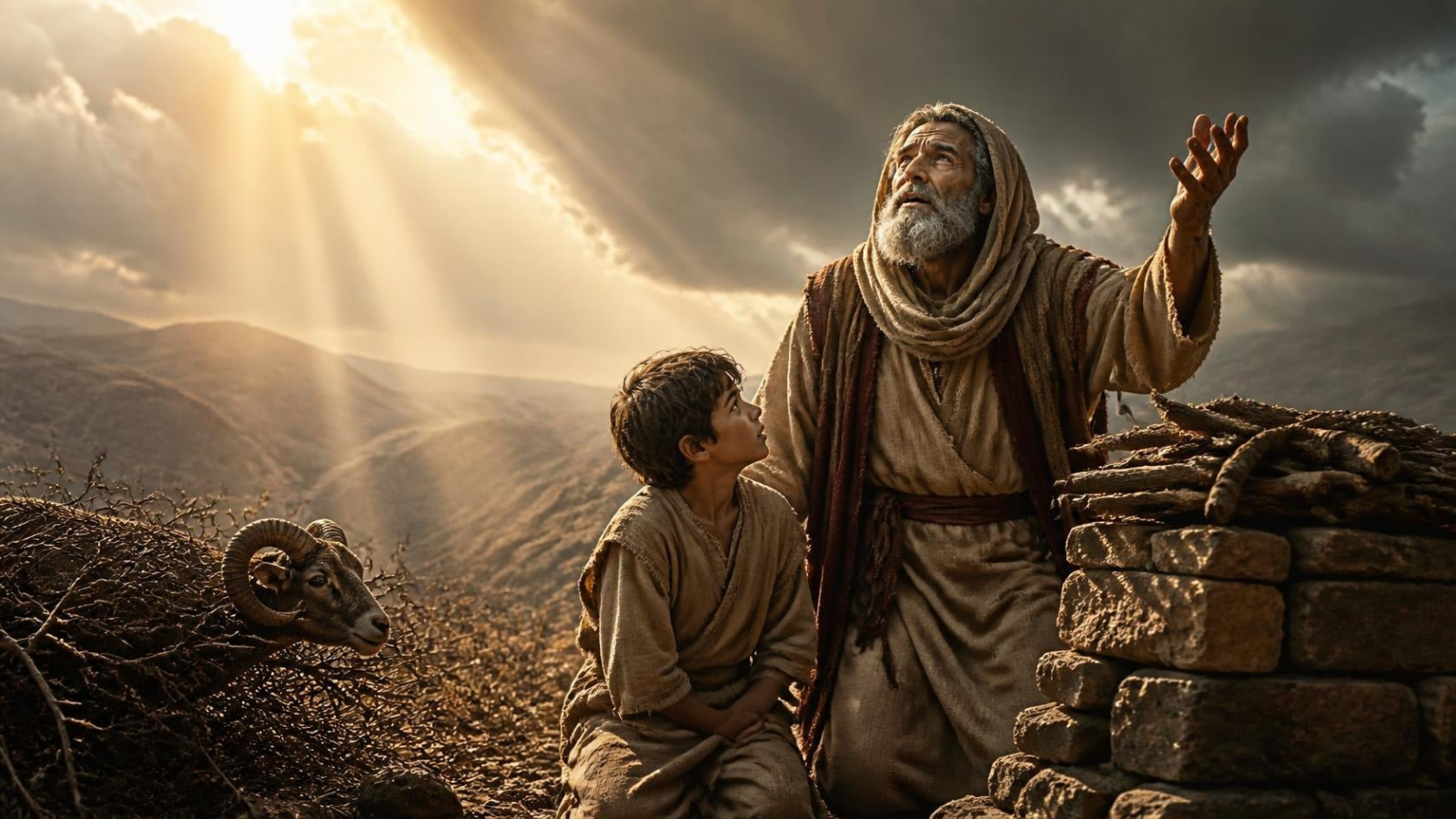
Abraham looks up and sees a ram caught by its horns in a thicket.
He takes the ram and offers it:
“in the stead of his son.”
This wording is crucial.
Isaac is spared.
The ram is sacrificed instead of Isaac.
The provision Abraham spoke of on the ascent has now become visible.
CHAPTER 18
The LORD Will Provide
Abraham names the place:
“Jehovahjireh”
commonly expressed as The LORD Will Provide.
Genesis connects the name directly with what happened upon the mountain.
God supplied what was required for the offering while preserving Isaac.
Abraham had told his son that God would provide.
Now he commemorates that provision.
CHAPTER 19
The Promise is Reaffirmed
The angel of the LORD calls to Abraham again.
Because Abraham has obeyed and has not withheld his son, God solemnly reaffirms promises already woven through Abraham’s story:
his offspring will be greatly multiplied;
they will be compared with the stars of heaven and sand upon the seashore;
and his offspring will possess the gate of their enemies.
The test concludes not with the destruction of the promise, but with its reaffirmation.
CHAPTER 20
Blessing for All Nations
The reaffirmation reaches beyond Abraham’s own household:
“And in thy seed shall all the nations of the earth be blessed…”
—Genesis 22:18
This recalls God's original promise in Genesis 12.
Abraham’s story has always pointed beyond Abraham.
God's purpose encompasses all nations of the earth.
Abraham and Isaac return to the young men and go together to Beersheba.
Abraham continues dwelling there.
Isaac lives.
The promise continues.
And the biblical story moves forward toward the fulfillment of God's blessing among the nations.
Key Truths
Scripture explicitly states:
God tests Abraham — Genesis 22:1.
Isaac is identified as the son Abraham loves — Genesis 22:2.
God commands Abraham to offer Isaac — Genesis 22:2.
Abraham obeys and travels to the appointed place — Genesis 22:3–10.
God stops Abraham before Isaac is killed — Genesis 22:11–12.
A ram is offered instead of Isaac — Genesis 22:13.
Abraham names the place in relation to the LORD's provision — Genesis 22:14.
God reaffirms the promises concerning Abraham’s offspring and blessing to the nations — Genesis 22:15–18.
Reasonable biblical inference:
Abraham’s statement that he and Isaac would return together is consistent with his confidence that God's promise concerning Isaac could not ultimately fail.
Here we can go further than inference because Hebrews 11:17–19 later explicitly explains that Abraham reasoned God was able to raise Isaac from the dead.
Interpretive safeguard:
Genesis 22 explicitly presents the ram as being sacrificed instead of Isaac. Christian theology rightly considers sacrifice, substitution, beloved-son language, Moriah, and God's provision within the larger canonical story culminating in Christ. However, we should distinguish those canonical connections from claims that Genesis explicitly labels every detail as a direct prophecy of Jesus.
Scripture Connections
Genesis 12:1–3 — God's original promise that all families of the earth will be blessed through Abraham.
Genesis 17:19–21 — God establishes His covenant through Isaac.
Genesis 21:12 — God declares that Abraham’s covenant offspring will be called through Isaac.
2 Chronicles 3:1 — Later identifies Mount Moriah with the location of Solomon's temple.
Hebrews 11:17–19 — Explains Abraham’s faith concerning Isaac and resurrection.
James 2:21–23 — Uses Abraham's offering of Isaac when discussing faith demonstrated through works.
Romans 8:32 — Later Christian readers encounter striking canonical resonance in God's giving of His own Son, though Paul is not presenting Romans 8:32 as a direct exposition of Genesis 22.
CONTINUE THE JOURNEY
From the Mountain of Provision to the Death of Sarah
Abraham returns from Moriah with Isaac alive and God's covenant promises reaffirmed. Genesis then briefly records the family of Abraham’s brother Nahor—including the first mention of Rebekah—before the narrative turns to sorrow.
Sarah dies at Hebron.
Abraham mourns for the woman who journeyed with him from Mesopotamia, shared the years of waiting, and finally bore Isaac, the promised son. Her death also leads to another important development in the promise of the land: Abraham purchases the cave of Machpelah as a permanent burial possession in Canaan.
Next Study
Genesis Study No. 38 — Sarah Dies — Abraham Purchases the Cave of Machpelah
Primary Scripture: Genesis 22:20–23:20