
Genesis Journey · Study No. 36
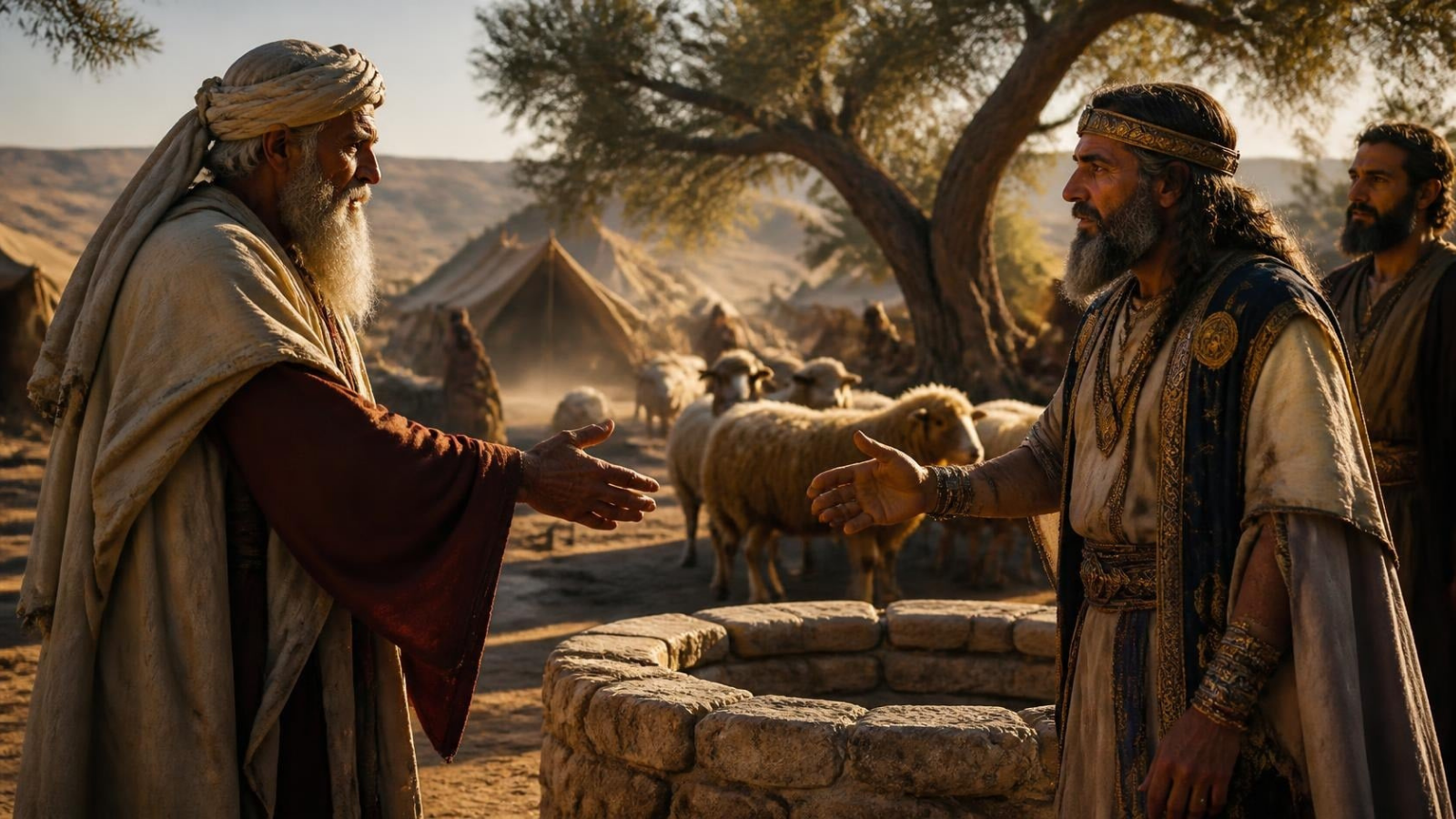
Abraham and Abimelech at Beersheba – A Covenant and a Well
Abimelech Recognizes God’s Favor upon Abraham, and Their Covenant Establishes Peace at Beersheba
Genesis 21:22-24
Study Orientation
Study at a Glance
Primary Scripture
Genesis 21:22-24
Central Theme
Abimelech recognizes that God is with Abraham. Their covenant at Beersheba settles a dispute over a well and establishes peaceful relations between them.
Central Truth
God’s faithfulness to Abraham becomes visible even to those outside his household. At Beersheba, Abraham acts with integrity, secures access to the well, and calls upon the LORD, the everlasting God.
Journey Position
Genesis Journey · Study No. 36
Reading Covenant, Witness, and Worship Faithfully
Genesis 21:22–34 may initially appear to be a quiet political agreement following the dramatic events surrounding Isaac, Hagar, and Ishmael. Yet the passage advances several important themes in Abraham’s journey.
Abimelech openly acknowledges that God is with Abraham. A dispute concerning a well is addressed through testimony and covenant. The name Beersheba becomes connected with these events, and Abraham concludes the episode by planting a grove and calling upon the name of the LORD, the everlasting God.
This study will distinguish carefully between what Genesis explicitly records, reasonable conclusions arising from the narrative, and later theological interpretation. Particular care will be taken not to assign symbolic meaning to the well, the seven ewe lambs, or the grove beyond what the text itself supports.
CHAPTER 1
At That Time
Genesis 21:22 begins:
“And it came to pass at that time…”
The narrative remains within the period surrounding Abraham’s life at Beersheba.
Isaac has been born. Hagar and Ishmael have departed. Now attention turns again to Abraham’s relationship with the people among whom he is dwelling.
A new development begins when Abimelech approaches him.
CHAPTER 2
Abimelech Returns to Abraham
Abimelech has appeared previously in Genesis 20, when Abraham entered Gerar and again identified Sarah as his sister.
God intervened to protect Sarah, and Abimelech returned her to Abraham.
Now Abimelech approaches Abraham under very different circumstances.
Rather than confronting Abraham over Sarah, he comes seeking an agreement.
CHAPTER 3
Phichol, Captain of the Host
Abimelech does not come alone.
Genesis identifies:
“Phichol the chief captain of his host.”
The presence of his military commander gives the meeting an official character.
This is not simply a casual conversation between neighbors. Abimelech appears to be dealing with Abraham as someone whose growing household and influence deserve serious attention.
CHAPTER 4
"GOD is With Thee"
Abimelech tells Abraham:
“God is with thee in all that thou doest.”
—Genesis 21:22
This is a remarkable testimony.
God’s activity in Abraham’s life has become visible to an outside observer.
Abimelech does not need to understand every aspect of God’s covenant with Abraham to recognize that Abraham is experiencing unusual divine favor.
CHAPTER 5
Abraham's Life Becomes a Witness
God had promised to bless Abraham.
Now another ruler acknowledges that God is with him.
This does not mean Abraham has lived without failure. Genesis has recorded his fear and poor judgment as well as his faith.
Yet God has remained faithful to His word.
The testimony therefore ultimately points beyond Abraham’s ability to the faithfulness of the God who called him.
CHAPTER 6
Abimelech Requests an Oath
Abimelech asks Abraham to swear by God that he will not deal falsely with him.
His request extends beyond himself to his son and his son’s son.
He seeks dependable relations extending into the future.
The request shows that trust must be established deliberately between the two households.
CHAPTER 7
Remembering Abimelech's Kindness
Abimelech appeals to his previous treatment of Abraham:
“according to the kindness that I have done unto thee, thou shalt do unto me…”
He asks Abraham to respond with similar faithfulness.
Their earlier relationship had been strained by Abraham’s deception concerning Sarah.
The present encounter offers an opportunity to establish their relationship upon clearer terms.
CHAPTER 8
Abraham Agrees
Abraham responds simply:
“I will swear.”
He accepts Abimelech’s request.
But before the covenant is finalized, Abraham raises an unresolved problem.
Peace cannot be securely established while a legitimate grievance remains unaddressed.
CHAPTER 9
Abraham Reproves Abimelech
Genesis 21:25 says Abraham reproves Abimelech because of a well of water.
Abimelech’s servants had violently taken it away.
In an arid environment, access to water is essential for people, livestock, and settlement.
This is therefore not a trivial disagreement.
The disputed well threatens Abraham’s ability to remain securely in the region.
CHAPTER 10
Abimelech Denies Knowledge
Abimelech answers:
“I wot not who hath done this thing…”
He says Abraham had not previously told him about it and that he had only heard about the matter that day.
Genesis does not tell us that Abimelech ordered the seizure.
We should therefore not accuse him of something the passage does not state.
His recorded response is that he did not know who had done it.
CHAPTER 11
The Dispute is Brought into the Open
The conversation demonstrates an important narrative principle.
Abraham does not simply carry resentment while making an outward agreement.
He identifies the disputed matter.
Abimelech responds.
The grievance can therefore become part of the covenant settlement rather than remaining hidden beneath it.
CHAPTER 12
Abraham Gives Livestock
Abraham takes sheep and oxen and gives them to Abimelech.
Then Genesis states:
“both of them made a covenant.”
The exchange accompanies the formal agreement.
The relationship between Abraham and Abimelech now receives a defined covenant framework.
CHAPTER 13
Seven Ewe Lambs Set Apart
Abraham separates seven ewe lambs from the flock.
Abimelech notices this unusual action and asks:
“What mean these seven ewe lambs which thou hast set by themselves?”
The question allows Abraham to explain their purpose directly.
We therefore do not need to speculate about their meaning.
Genesis tells us why Abraham separated them.
CHAPTER 14
A Witness Concerning the Well
Abraham says Abimelech should receive the seven ewe lambs:
“that they may be a witness unto me, that I have digged this well.”
The lambs function as testimony regarding Abraham’s claim to the well.
The issue is not merely who may draw water.
Abraham establishes publicly that he was responsible for digging it.
CHAPTER 15
The Naming of Beersheba
Genesis explains:
“Wherefore he called that place Beersheba; because there they sware both of them.”
The name becomes associated with the oath made there.
Beersheba will become an important location throughout the biblical story.
Here its significance is rooted in Abraham and Abimelech’s covenant.
CHAPTER 16
The Covenant Is Completed
Genesis 21:32 states:
“Thus they made a covenant at Beersheba.”
The dispute has been addressed.
The oath has been made.
The relationship has been formally settled.
Abraham can continue living in the region with an acknowledged claim concerning the well.
CHAPTER 17
Abimelech and Phichol Depart
After making the covenant, Abimelech and Phichol rise and return to the land of the Philistines.
Their departure is peaceful.
The meeting began with concern about future relations and contained a serious grievance regarding the well.
It ends with agreement rather than conflict.
CHAPTER 18
Abraham Plants at Beersheba
Genesis then records that Abraham plants a grove—or, depending on translation, a tamarisk tree—at Beersheba.
The text does not explicitly explain why Abraham plants it.
We should therefore resist constructing elaborate symbolism around the act.
What Genesis emphasizes immediately afterward is Abraham’s worship.
CHAPTER 19
Abraham Calls Upon the LORD
At Beersheba Abraham:
“called there on the name of the LORD…”
Calling upon the LORD has already appeared in Abraham’s journey.
His life is not defined merely by livestock, wells, treaties, and land.
At significant locations throughout his pilgrimage, Genesis repeatedly returns to Abraham’s relationship with God.
CHAPTER 20
The Everlasting GOD
Genesis 21:33 gives God a striking title:
“the LORD, the everlasting God.”
The Hebrew expression is El Olam—God everlasting, or the everlasting God.
Abraham’s circumstances continue to change.
People come and go.
Conflicts arise and are settled.
Isaac grows.
Hagar and Ishmael have departed.
Abraham himself remains a sojourner.
But the God who called Abraham is not temporary.
He is the everlasting God.
Genesis 21 concludes by saying Abraham sojourned in the Philistines’ land many days.
The pilgrim continues his journey under the faithfulness of the eternal God.
Key Truths
Scripture explicitly states:
Abimelech recognizes that God is with Abraham — Genesis 21:22.
Abimelech asks Abraham for an oath of truthful dealing — Genesis 21:23.
Abraham raises the dispute concerning a seized well — Genesis 21:25.
Abraham and Abimelech make a covenant — Genesis 21:27, 32.
The seven ewe lambs serve as a witness that Abraham dug the well — Genesis 21:28–30.
Abraham calls upon the LORD, the everlasting God — Genesis 21:33.
Reasonable biblical inference:
Abimelech’s desire for a covenant appears connected with his recognition that Abraham enjoys God's favor and has become a significant presence in the region.
Interpretive safeguard:
Genesis itself explains the purpose of the seven ewe lambs: they witness Abraham’s claim concerning the well. We should not assign additional prophetic or symbolic meanings to them without biblical warrant.
Scripture Connections
Genesis 12:1–3 — God promises to bless Abraham and make him a blessing.
Genesis 20:1–18 — Provides the earlier history between Abraham and Abimelech.
Genesis 22:19 — Abraham returns to Beersheba following the testing involving Isaac.
Genesis 26:23–33 — Isaac later encounters Abimelech and experiences another dispute-and-covenant episode involving wells and Beersheba.
Psalm 90:2 — Scripture elsewhere confesses God’s eternal existence: “from everlasting to everlasting, thou art God.”
CONTINUE THE JOURNEY
Continue the Genesis Journey
With peace established at Beersheba, Genesis moves into one of the most profound and difficult episodes in Abraham’s entire journey. God tests Abraham by commanding him to take Isaac—the beloved son through whom the promise is to continue—and go to the land of Moriah.
Next Study
Genesis Study No. 37 — Abraham Is Tested — The Offering of Isaac
Primary Scripture: Genesis 22:1–19