
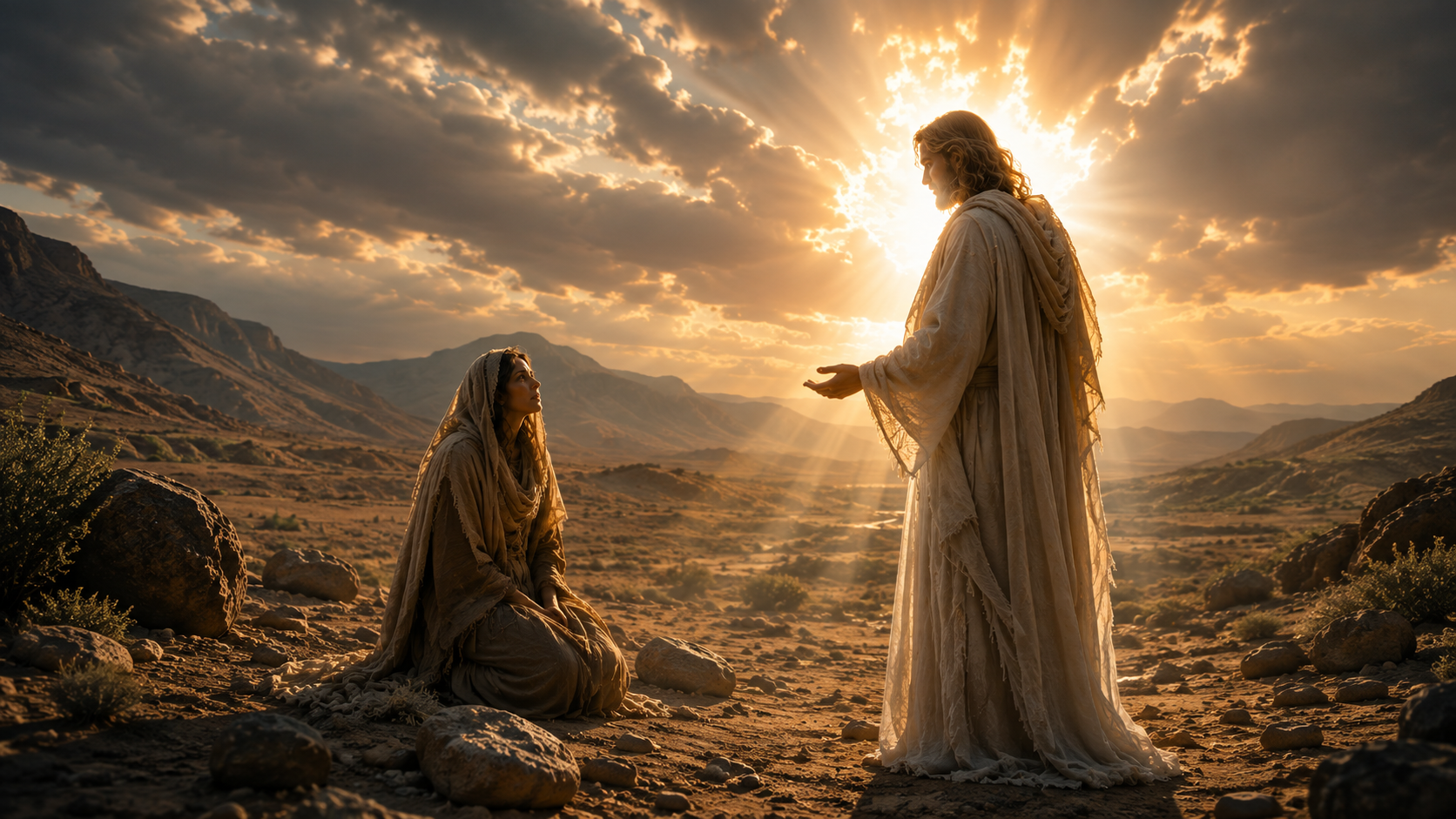
Sarai’s Plan, Hagar and Abram, Conflict in the Household, Hagar’s Flight, and the Angel of the LORD Who Finds Her in the Wilderness
Primary Scripture: Genesis 16:1–16
Editorial Preface — Reading Scripture First
Genesis 16 follows the covenant promises of Genesis 15 with a painful contrast. The LORD has promised Abram an heir from his own body, yet Sarai remains childless. As the years pass, Sarai proposes a human solution through Hagar, her Egyptian maid. Abram agrees, Hagar conceives, and conflict enters the household.
This article must therefore be read carefully and compassionately. Scripture records the actions of Sarai, Abram, and Hagar without requiring us to approve every human action described. We should distinguish what the text explicitly says from conclusions we might bring to it. At the center of the chapter stands a remarkable encounter in the wilderness. The angel of the LORD finds Hagar, speaks to her concerning her affliction and her unborn son, and gives the name Ishmael because the LORD has heard her distress. Hagar responds to the LORD who spoke to her as the God who sees her. Our governing safeguard remains Scripture first. We will follow Genesis 16 in its own order, allow later Scripture to illuminate the passage where appropriate, and distinguish clearly between what Scripture explicitly states, reasonable biblical inference, and later theological interpretation.
What This Passage Shows
Human attempts to accomplish God’s promise in their own way bring painful consequences, but human failure does not overturn God’s purpose. In the wilderness, the LORD sees Hagar, hears her affliction, speaks to her, and demonstrates His sovereign care for someone who is suffering and alone.
Sarai’s Barrenness and Long Waiting Frame the Crisis
Genesis 16 begins with a simple statement carrying enormous weight:
“Now Sarai Abram's wife bare him no children..” — Genesis 16:1
The words take us directly back to the promises already given to Abram. God had called Abram from his country and promised to make of him a great nation. Later, the LORD explicitly told Abram that his heir would come from his own body and that his descendants would be as numerous as the stars. Yet when Genesis 16 opens, there is still no child. This creates the tension that governs the chapter. But Abram and Sarai cannot yet see how it will be fulfilled. Genesis 16 should not be separated from the passing of time.
Abram and Sarai had already journeyed from Haran to Canaan. They had experienced famine, travelled into Egypt and returned, separated from Lot, witnessed the conflict of the kings, and heard the LORD reaffirm His covenant promises. Genesis 16:3 tells us that Abram had dwelt in Canaan for ten years when Sarai gave Hagar to him. Waiting therefore forms an important part of the narrative. The difficulty is not that God has failed to speak. The difficulty is that what God has spoken has not yet appeared. Delay is not the same thing as the failure of God's promise.
We should be careful not to put thoughts into Sarai's mind that Genesis does not record. Sarai subsequently proposed that Abram have children through Hagar. We can recognize the pressure created by childlessness and the long passage of time, but we should distinguish that reasonable inference from what Scripture explicitly states. The central issue in Genesis is not simply whether such an arrangement existed within ancient society. And God's faithfulness does not depend upon pretending otherwise.
“And Sarai Abram's wife took Hagar her maid the Egyptian.. After Abram had dwelt ten years in the land of Canaan..”
The text then tells us that Sarai gives Hagar to Abram “to be his wife.” At this point Hagar moves from the background of the narrative into its center. But as the chapter progresses, Scripture will show that she is not invisible to God. This becomes one of the great theological truths emerging naturally from Genesis 16. Human beings may treat another person primarily according to the role that person serves in their plans. Before we reach that encounter, however, Scripture requires us to confront the painful human situation that develops.
The reference to ten years is important because it helps us appreciate the pressure surrounding the decision without excusing it.
Sarai Gives Hagar to Abram, and Conception Brings Conflict
Biblical faith must ultimately rest not upon how quickly circumstances change but upon the trustworthiness of the One who speaks. Nothing Abram, Sarai, or Hagar does in Genesis 16 forces God to rewrite His purpose. Yet the LORD remains faithful to His covenant word. Genesis is teaching us to distinguish between God's promise and the human attempts made around that promise. But instead of resolving the problem, conception creates a new crisis. What appeared to be the solution now becomes the source of conflict. This is an important biblical principle, provided we state it carefully.
The fact that a human plan produces the intended immediate result does not by itself demonstrate that God approved the method. This is why biblical discernment cannot be based merely upon whether something works. The governing question remains whether our actions accord with God's revealed will. What began as Sarai's solution becomes tension between Sarai and Hagar. In the following verses, Sarai's response will intensify the conflict. The text does not invite us to simplify the narrative into one innocent person and one villain. Instead, Scripture exposes the brokenness of the entire situation.
This point must govern our reading of everything that follows. But God's covenant purpose is not descending into chaos. The LORD who promised remains the LORD who governs. And soon, when Hagar finds herself alone in the wilderness, Genesis will reveal something extraordinary: The God of Abram is also the God who sees Hagar. That revelation becomes one of the defining moments of this passage. Hagar has conceived, but the hoped-for solution has not brought peace.
“My wrong be upon thee..” — Genesis 16:5
Sarai reminds Abram that she herself had placed Hagar into his embrace. Yet after Hagar conceived, Sarai says that she became despised in Hagar's eyes. The household is now experiencing the consequences of a decision intended to overcome Sarai's barrenness. Sarai does not treat the conflict merely as a private disagreement between herself and Hagar.
“The LORD judge between me and thee.” — Genesis 16:5
This statement places the dispute beneath the judgment of God. But Scripture does not tell us here that the LORD commanded what Sarai or Abram had done. Nor does Genesis record God settling the dispute at this moment. But we should allow Genesis 16 itself to establish that truth before drawing broader connections. And eventually Hagar herself will respond to the LORD with one of the most memorable declarations in Genesis:
Hagar Flees, and the Angel of the LORD Finds Her in the Wilderness
After finding Hagar in the wilderness and asking where she has come from and where she is going, the angel of the LORD gives her a direct command:
“Return to thy mistress, and submit thyself under her hands.” — Genesis 16:9
These are difficult words, especially because Genesis has already told us that Sarai dealt harshly with Hagar. We should therefore handle this verse with care. The text records a particular divine instruction given to Hagar in a particular moment within the unfolding Genesis narrative. We should not turn Genesis 16:9 into a universal rule requiring every suffering or abused person to remain in, or return to, dangerous circumstances. That would go beyond what the passage says. Genesis records what the angel of the LORD told Hagar.
The LORD Hears Hagar’s Affliction and Promises Her Descendants
Our task is first to understand that command within Hagar's story. The LORD has already demonstrated that Hagar's situation matters to Him.
“the LORD hath heard thy affliction.” — Genesis 16:11
Therefore, the command to return cannot properly be interpreted as evidence that God was indifferent to what had happened to Hagar. If Genesis 16 ended with Hagar disappearing into the wilderness, the story of Abram's household would move forward without her. And Ishmael himself will become part of the continuing Genesis narrative. The command to return therefore stands within a much larger divine purpose. The angel of the LORD follows the command with an extraordinary promise:
“I will multiply thy seed exceedingly, that it shall not be numbered for multitude.” — Genesis 16:10
The angel does not merely predict that Hagar will have many descendants. Hagar entered the narrative as Sarai's Egyptian maid. Now she receives a promise concerning her own descendants. They will become so numerous that they cannot be counted for multitude. This does not mean that Hagar and Ishmael replace the covenant line that Genesis will continue to trace. Later Scripture will make clear that the covenant will be established through Isaac. But neither should that later distinction cause us to minimize what God actually promises Hagar here. God's covenant purpose will continue through the promised son.
And God genuinely promises multiplication to Hagar's descendants. This becomes an important theme as Genesis progresses. God's special covenant purposes do not imply that He is unconcerned with everyone outside that covenant line.
Scripture allows us to affirm God's unique covenant purpose while simultaneously recognizing His providential care and blessing beyond that line.
The divine message speaks directly about Hagar’s future motherhood. Scripture does not therefore portray Ishmael as invisible to God.
Hagar Calls the LORD the God Who Sees Her
After hearing the command, promise, and prophecy spoken concerning her and her unborn son, Hagar responds:
“And she called the name of the LORD that spake unto her, Thou God seest me..” — Genesis 16:13
This is the defining moment of Genesis 16.
“And the angel of the LORD found her..” — Genesis 16:7
This is one reason the identity of the angel of the LORD has received considerable theological attention. But our Scripture-first approach requires us to preserve the wording before constructing theological conclusions. We should neither ignore it nor claim that Genesis 16 explicitly provides every later theological explanation of it. Hagar's response brings together the entire wilderness encounter.
Beer-lahai-roi Preserves the Memory of Hagar’s Encounter with the LORD
God's seeing in this passage is not presented as distant observation. The God who sees is also the God who acts. We should first allow Genesis 16 to speak about Hagar. But the wider testimony of Scripture repeatedly affirms God's complete knowledge of human life. Psalm 139 declares that the LORD knows our sitting down and rising up and understands our thoughts afar off. Jesus later teaches that even the hairs of our heads are numbered. Those passages deepen our understanding of divine knowledge. Yet Hagar's testimony stands powerfully on its own: She discovered in the wilderness that she had never been outside God's sight.
“Wherefore the well was called Beer-lahai-roi..” — Genesis 16:14
The location now carries the memory of what happened there. Hagar came to a fountain in the wilderness as a fugitive. She leaves that encounter knowing that the living God sees her. The significance is not merely that Hagar was noticed by some spiritual force. Genesis has already revealed the LORD as Creator, Judge, Deliverer, Covenant Maker, and the God who calls Abram. Genesis 16 now displays another dimension of His character within the narrative.
Later, Genesis 24:62 associates Isaac with the way of the well Lahai-roi, and Genesis 25:11 says that after Abraham's death, Isaac dwelt by the well Lahai-roi. The place therefore remains woven into the continuing patriarchal narrative. What began as Hagar's wilderness encounter leaves a geographical memory within Genesis itself.
Hagar Bears Ishmael, and the Word Spoken in the Wilderness Is Fulfilled
The wilderness where Hagar was vulnerable became the place where God addressed her. Hagar returned with something she did not have when she fled:
“And Hagar bare Abram a son: and Abram called his son's name, which Hagar bare, Ishmael.” — Genesis 16:15
The word spoken in the wilderness comes to pass.
“thou shalt call his name Ishmael..” — Genesis 16:11
Now Abram gives the child that very name. Genesis does not explain in this verse precisely how Abram learned the divinely given name. The child is born, and his name is Ishmael. The name given in the wilderness now enters Abram's household. The child's name permanently carries the testimony of Hagar's encounter. Every mention of Ishmael recalls, at least linguistically, that foundational truth. This is especially meaningful because Ishmael's birth emerged from a deeply troubled human situation. His existence is not treated by Scripture as an embarrassment that must be hidden.
And the covenant story continues according to God's word.
Conclusion — What This Passage Shows
Human attempts to accomplish God’s promise in their own way bring painful consequences, but human failure does not overturn God’s purpose. In the wilderness, the LORD sees Hagar, hears her affliction, speaks to her, and demonstrates His sovereign care for someone who is suffering and alone. Sarai and Abram seek to obtain the promised offspring through Hagar, bringing conflict and suffering into the household. Yet the LORD finds Hagar in the wilderness, hears her affliction, speaks to her concerning her son, and Hagar recognizes Him as the God who sees her.
Join the Conversation
After reading Genesis 16:1–16, what truth from this passage stands out most clearly to you, and how does it shape your understanding of God and His purposes?
Take a moment to reflect on the passage and share your thoughts in the comments below. Your reflection may encourage another reader in their own journey through God’s Word.
Go Deeper
This article is drawn from a fuller Platinum Study with deeper exposition, Scripture connections, key truths, and interpretive safeguards.